FTTx:
Fiber To The Home/Premises/Curb/etc. @ FOA
The
term FTTx is used as a catch-all for fiber to the home,
premises, business and even the hybrid fiber to the curb.
Mostly we're concerned with fiber to the home, but we will
discuss all options.
Broadband
connections to the home began in 1997 with the installation
of the first cable modems by CATV companies. Telcos were
left to try to get high speeds over copper networks, but
twisted pair wires were inferior to coax used by CATV. CATV
became the dominant provider of broadband. In the years
since, the backbones for both telco and CATV were upgraded
to fiber, but even after the development of more than 20
generations of equipment, DSL (digital subscriber line) over
twisted pair phone lines was clearly an inferior product.
DSL continued until about 2020 when the last telco holdouts
gave up.
Beginning around 2006-7, fiber to the home (FTTH) began
emerging. Two factors made the cost low enough to justify
replacing aging copper wires, the decline in fiber optic
component costs following the fiber recession caused by the
bursting of the Internet "bubble" in 2001 and the
development of passive optical networks (PONs).
- Fiber
has now gained acceptance in the final frontier of
telecom networks, the "last mile," the connection to the
home. Many homes, apartments and businesses are still
connected with aging, low performance copper telephone
wire that cannot support connection speeds for broadband
access.
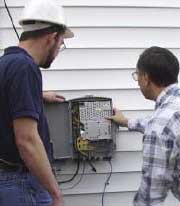 The costs of maintaining these old copper cable plants
is also extremely high and increasing. Even when
landlines are abandoned for mobile phones, the home
needs a connection capable of providing high speed
Internet access and fiber is the most logical - and
economic - choice, providing gigabit+ speeds with plenty
of room to upgrade.
The costs of maintaining these old copper cable plants
is also extremely high and increasing. Even when
landlines are abandoned for mobile phones, the home
needs a connection capable of providing high speed
Internet access and fiber is the most logical - and
economic - choice, providing gigabit+ speeds with plenty
of room to upgrade.
Phone companies, cities, utilities, commercial service
providers and even real estate developers are now
realizing the best choice for upgrading the subscriber
connection is fiber to the premises or home (FTTP, FTTH)
although fiber to the curb (FTTC) or fiber to wireless
(FTTW) may still be used where appropriate. Wireless
connections to the home using WiFi are being used in
many rural areas where line-of-sight wireless links are
feasible. The possibility of delivering new services
(the triple-play of phone, Internet and streaming video)
and low priced components for with new network
architectures make FTTx financially attractive.
Companies are spending billions of dollars connecting
millions of homes and offices with fiber.
CATV companies who have used hybrid fiber-coax systems
in their backbones for decades even have their own
standard for fiber to replace coax, since the cost of
fiber is reasonable and performance unlimited.
Municipalities or private individuals are installing
their own FTTH systems when phone or CATV companies
won't do it soon enough. Electrical and telephone coops
are installing fiber in areas where the usual service
providers won't because they don't see a large return on
their investment. Housing developers are learning about
FTTH because their customers are demanding the highest
bandwidth broadband connections.
FOA's Role In FTTH
As the worldwide professional organization for fiber optics
and the widely-accepted certifying body for fiber optic
techs, FOA has had a major role in FTTH development. As
noted below, we have been involved in training and
certifying fiber optic techs for FTTh from the beginning.
But in the process of developing standards for FTTH tech
certification and creating reference materials for the FOA
Guide and curriculum materials for our FOA-approved schools,
we have developed an in-depth understanding of the
technology and applications of FTTH. FOA has helped hundreds
of organizations to design, install and operate FTTH
networks - and in many cases help them make the decision to
move ahead with the project by guiding them through
technical, financial and logistical decisions that they
needed to make.
- Training
FTTH Techs
All these plans depend on finding or training adequate
numbers of technicians. The FOA, since being approached
by Verizon to develop training for FiOS techs in 2006, has
been working with operating companies, municipalities,
installers and our approved schools to develop
requirements for FTTx training and certification, with
the goal of providing enough qualified FTTx installation
technicians to make these plans possible.
-
- FOA
CFOS/H Certified FTTH Technician certification programs
are now being taught in many FOA-approved schools.
Students seeking certification must complete the FOA
CFOT program first to obtain their first level
certification, then attend a course on FTTx that will
prepare them for the CFOS/H exam. Some techs attend
courses for the FOA CFOS/D fiber optic network design
certificaiton first, since they are tasked with
designing the networks.
- Those
interested in learning about FTTx but are not seeking
certification will find the courses good information on
the current technology.They can also take self-study
courses on Fiber
U, FOA's free online learning website.
- Technical
Information on FTTX from the FOA
Online Reference Guide:
- FTTH
Introduction
- FTTH
Architectures
- FTTH
PON Standards and Protocols
FTTH
Network Design
FTTH
in MDUs (Multiple Dwelling Units)
FTTH
Installation
FTTH
Customer Premises Installation
Testing
FTTH Networks
FTTH
Case Studies: Do-It-Yourself FTTH
Migration from GPON to 10GPON
FOA
books covering FTTH:
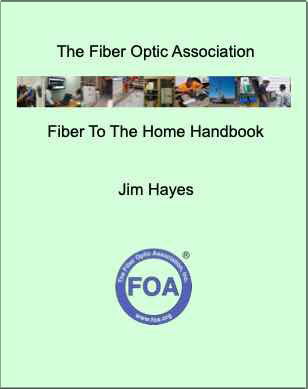
The
Fiber Optic Association Fiber To The Home Handbook
For Planners, Managers, Designers, Installers And Operators
Of FTTH - Fiber To The Home - Networks
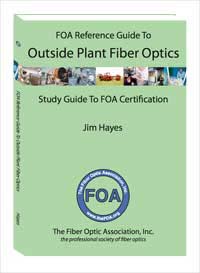
FOA
Reference Guide to Outside Plant Fiber Optics,
Appendix B
- FOA
Training & Certification
Fiber
U FTTx Online Self-Study Course (free)
- FOA
Certification Overview
FOA FTTx Certification
Requirements
FOA-Approved
Training Programs
FOA
Online Guide Table of Contents
|