FTTH:
Fiber To The Home
Since the first installations of fiber optic
networks in the late 1970s, the goal of the fiber optic
industry has been to install fiber optics all the way to
the home. Telecommunications systems were usually divided
into long distance, metropolitan and subscriber
categories. In the beginning, the challenge was well known
- 10% of the cable plant was in long distance, 10% was in
metro and fully 80% of the cable plant was the "last mile"
- the subscriber. The issue was, and is, the economics of
fiber to the home (FTTH.)
From an economic standpoint, fiber was
immediately cost effective in the long-distance networks.
Compared to copper or digital radio, fiber’s high
bandwidth and low attenuation easily offset its higher
cost. Compared to copper wire used in telephony, fiber
could carry thousands of times more phone conversations
hundreds of times further, making the cost of a phone
connection over fiber only a few percent as much as
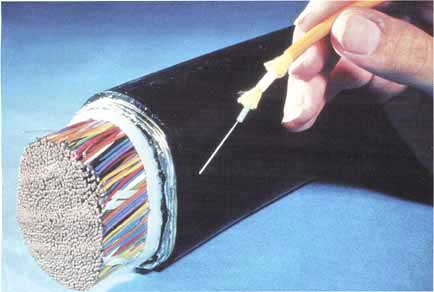
transmitting over copper.This photo was used many times in
the early days to illustrate the information carrying
advantage of optical fiber:
It took only a few years before the rapidly advancing
technology of fiber optics led to widespread use and fiber
quickly dominated the long distance market. Crews buried
cables underground or ran aerial cables on poles nonstop
for a decade to upgrade long distance service. At the same
time, technology was developed for submarine cables and by
the late 1980s, all overseas communications expansion was
done by fiber optics, replacing copper cables and
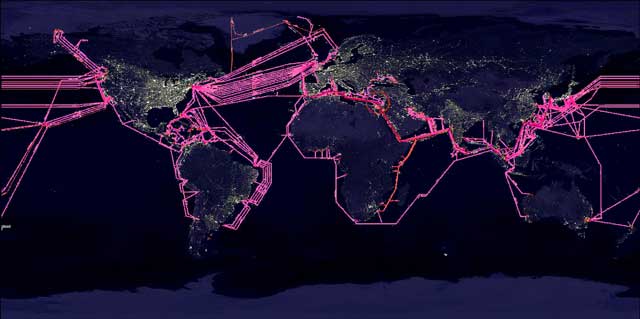
satellites. Today, virtually all long distance
communications is carried over the installed fiber optic
network both on land and via hundreds of submarine cables
as shown below.
The next step was connecting local central offices, the
link between subscribers and the switched phone network.
Around the time the long distance networks were being
completed, consumer use of the Internet took off. It was
the Internet that drove the communications revolution by
connecting anyone with a PC to a worldwide source of
information and communication and forced the expansion of
fiber into communications networks. Metropolitan phone
networks became overloaded quickly and fiber optics was
ready to provide the expansion capability. The scope of
metropolitan fiber optic installations was obvious to
anyone driving around almost any town, as it was hard to
drive anywhere without encountering roads torn up for the
installation of conduit and fiber optic splicing trucks
blocking the roadways.
While telecom companies were building
out their backbone networks, CATV companies benefited from
several technical developments. The Internet created a
need for high speed "broadband" networks. A way of using
CATV networks for Internet access using the frequencies
from several TV channels was developed leading to the
cable modem. And finally the DFB laser capable of
converting CATV analog signals to optical was developed to
allow companies to build a hybrid fiber coax CATV network.
CATV companies ran with the idea and began offering
broadband Internet service in 1997, jumping ahead of the
telecom networks to become the dominant broadband
providers.
Then the telecom/Internet "bubble"
burst in 2001. The Internet “bubble” that caused the
telecom “bubble” and thereby the fiber optic “bubble”
caused the downfall of a tremendous number of companies
and left the industry with a glut of both installed fiber
backbone capacity and fiber optic component manufacturing
capacity. In a good illustration of economics at work, the
cost of fiber optic components took a nosedive as supply
outstripped demand. Since the market bust, fiber and
component prices became very cheap. One analyst compared
fiber prices to kite string and fishing line, both of
which are more expensive than the current prices of top
quality optical fiber. That set the stage for the next big
application for fiber optics.
Many homes today are still connected
with aging, low-performance copper telephone wire that
cannot support DSL connection speeds that allow the phone
companies to compete with the cable modems used by CATV
companies for broadband access. These aging phone lines
not only cannot carry high bandwidth digital signals, they
are extremely expensive to maintain just for POTS (plain
old telephone service.) Savings in maintenance alone were
projected by a 2005 Telcordia report to pay back the cost
of installing fiber in under 20 years, irrespective of
revenue from new services.
One problem with converting homes from
copper to fiber was the immense size of the task. Long
distance cables represent about 10% of the telecom
network. Metropolitan networks represent another 10%. But
the connection to the home, traditionally called the "last
mile," represents about 80% of all the cabling in telecom,
making conversion of copper to fiber to the home a massive
task.
Besides component prices dropping as a
result of oversupply, new network architectures have been
developed that allow sharing components for FTTH
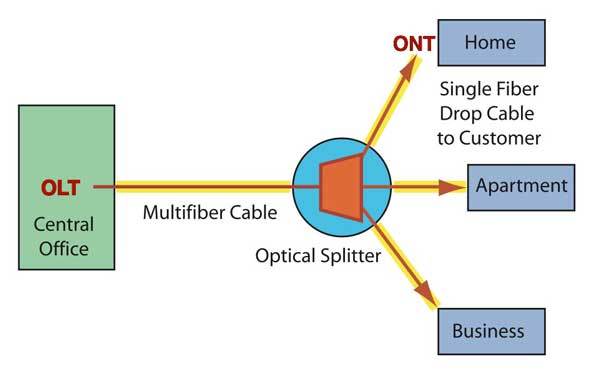
that further reduces cost. A passive optical splitter that
takes one fiber input and connects bi-directionally to as
many as 32 users cuts the cost of the links substantially
by sharing, one expensive laser transmitter with up to 32
homes and reducing the number of fibers needed. This is
what is called a PON network, or passive optical network.
More
on FTTH network architecture and protocol.
Each home needs to be connected to the
local central office or head end with singlemode
fiber, through a splitter generally placed close to
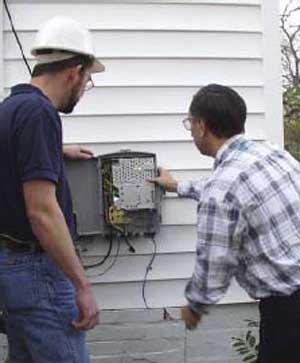
the homes connected to it. Every home will have a
singlemode fiber link placed underground or aerial to the
cables running down the street and a network interface
device containing fiber optic transmitters and receivers
will be installed on the outside of the house. The
incoming cable needs to be terminated at the house,
tested, connected to the interface and the service tested.
So fiber has now gained acceptance in the final frontier
of telephone networks, the “last mile”—the connection to
the home. Phone companies are now realizing the only
choice for upgrading the subscriber connection is fiber to
the home (FTTH). Service providers have committed billions
of dollars to connecting millions of home with fiber.
With FiOS in 2006-7, Verizon became the
leader in the US in FTTH, but the US trails many other
countries around the world in converting to FTTH. Progress
requires massive capital investment and training lots of
people to install FTTH, or FTTP (fiber to the premises as
they call it.) Besides
the telcos, several other groups are installing FTTH.
National governments: Countries with a national telecom
policy usually favor FTTx for their national broadband
networks. In 2021, the highest percentage of users
connected on FTTH was in UAE where Etisalat has connected
virtually all homes (Etisalat is an FOA approved school
also.) Some homes may be connected with fiber, but where
FTTH is too expensive, wireless or satellite connections
may be preferred.
Even the CATV companies are considering fiber to replace
aging coax, since the price is right and performance
unlimited.
Municipalities: Some of the first FTTH systems were
installed by cities - progressive ones like Palo Alto, CA
did it at the request of their high-tech citizens, some
did it to entice businesses to move there, like Anaheim,
CA some did it (or are trying to) because they were not
pleased with the service of telcos or CATV companies. The
latter often found the telcos or CATV companies to be
formidable opponents who did not always play fair! Most
municipal FTTx projects use rights of way available to the
city through city-owned utilities such as Chattanooga,
Clarksville and Jackson, TN which offer 1Gb/s FTTH
already.
Google Fiber made municipal FTTH
popular by having a competition for a city to get Gigabit
FTTH installed by them - and Kansas City won the
competition but many other cities decided they wanted
fiber optics anyway and they are now running their own
networks. Google fiber had many successes and some notable
failures but they convinced many other organizations to
commit to gigabit broadband over fiber.
Utilities: Owning rights of way to the home convinced some
utilities to try FTTH or FTTC. Ethernet over power lines
was once considered an option for power companies ton use
power lines for the final connection to the home, but the
technology was inadequate. FTTx is even becoming real for
many customers through electrical cooperatives. The best
example of a utility-owned FTTH network is the EPB system
in Chattanooga, TN.
Private companies: There are private companies that will
build municipal FTTH networks under an agreement with the
city, similar to CATV agreements. In addition, some
contractors and real estate developers building
subdivisions or apartments are installing FTTH so they can
connect with telecommunications companies for services to
resell.
Google Fiber is certainly the largest and best known of
the private FTTH networks. Google started in Kansas City,
then added Austin and Provo, Utah and began adding up to
34 other cites to their service areas. What Google appears
to have learned from Kansas City was when the city is
cooperative, FTTH is relatively cheap to install (KC
numbers have been quoted as low as <$500 per customer)
and provides a constant stream of high margin income.
As of 2021, there are thousands of FTTH
projects around the world. Many are being done by telecom
companies like Etisalat. Cities, counties and even states
are building fiber optic networks to serve citizens. Real
estate developers are building FTTH networks because the
cost is lower than a upgraded kitchen, helps sell houses
faster and brings much more profit. Even venture capital
has begun investing in FTTH networks for the potential
return on investment.
Here
is a Google Map of worldwide FTTH Projects.
What Makes
A Successful Fiber Optic Project?
People call FOA for advice all the time. Most of the calls
deal with technical questions about products, installation
and testing. But in one call; a manager who was starting
to plan a fiber optic project wanted advice on how to
proceed. It was a long call! His basic question was “What
does it take to have a successful fiber optic project?” We
responded with 4 words: financing, commitment, expertise
and patience.
Financing: The story goes that
someone asked Neil Armstrong what he was thinking about
while sitting on top of the rocket ready to launch Apollo
11 to the moon. “Every part was made by the lowest
bidder,” was supposedly his reply. (The same quote has
been attributed to most early astronauts!)
Fiber optics are not necessarily
expensive; in fact, fiber has been used so widely because
it is the least expensive communications medium in
virtually all projects. But fiber optic projects may
require a lot of construction which makes the project
expensive. Like all other projects, it never pays to cut
corners. Planning and running the project properly is what
saves money, trying to cheapen the project. Not all jobs
should go to the lowest bidder, unless they meet all the
criteria for a qualified bidder. Likewise, one needs to
ensure that when a project starts, there are funds
available to complete the job properly, including some
extra for unplanned changes or modifications.
Commitment: Just like having
sufficient finances to compete the project, one needs a
commitment to finish the job once it is started. Changes
of management or changes in governments often lead to
confusion or even modifying a project in midstream. There
is nothing wrong with making changes based on what learns
as the project progresses; it may even involve greater
efficiency or cost savings, but arbitrary changes may
jeopardize the project's timetable, completion or even its
usefulness.
If the project is under the auspices of
a government entity, changes in administration or
management that causes changes in a project will
invariably make it more expensive and may jeopardize the
success of the entire project. Ideally, the personnel who
propose, design and plan the network should see it to
completion.
Expertise: Fiber requires
expertise and experience. It's obvious the installers need
to know what they are doing, but in reality, so must the
managers who work for the organization that is contracting
for the work. There are many instances of projects where
the managers signed off on the project when it was
incomplete or improperly installed. The only way to
properly manage a project is to understand every aspect of
it well enough to know if it is being done properly and
when it is actually complete.
Planners, designers, contractors and
installers should all be trained and certified
as well as being experienced with good references. That
holds doubly so for consultants. In many places, to be a
consultant or cabling contractor means little other than
registering as a business and advertising your services.
Some of the problems we've seen with outside services,
include consultants who took contracts, spent time on a
project, then told the customer they could not help them
with the project, but kept the money.
We have seen contractors doing shoddy
installations, ruining expensive fiber optic cable during
pulling and leaving jobs half done but getting paid
because the customer knew no better. One of the biggest
problems is subcontractors. A contractor with good
credentials gets the job but subcontracts some of the work
to a contractor who will do the work at a lower price, but
does not have the training or experience (or motivation)
to do it right. In your contract with an installer, we
recommend a clause giving the project manager
responsibility for evaluating and approving all
subcontractors.
The manager must know better to prevent
problems. FOA also has pages on what
the manager needs to know.
Patience: From concept to
acceptance, a typical OSP fiber project can take 2-5 years
and a premises project 1-2 years. It depends on the size
of the project, the time to properly design it, create
project paperwork, get permits, buy components, hire
contractors and properly install it. Proper
workmanship takes time and is not easily rushed. Saving
time generally means cutting corners and that is often the
cause of the problems encountered. Take your time, plan,
design, select, install, test and document your network
properly.
And by the way, "future proofing" is a
myth! Who would have known in 1990 how ubiquitous the
Internet would be today? How reliant we could be on
smartphones other mobile devices? How many workers would
be working remotely or using videoconferencing for
meetings? Technology moves too fast and is too disruptive
for anyone to make reliable predictions. The IBMer who
developed MRP - the original company organizational
software - used to tell everyone, "A forecast is wrong
from the moment it is made." Plan for the future, but
assume you will upgrade, change directions, etc. driven by
new tech and changes in the world around us.
The
Fiber Optic Association Fiber To The Home Handbook: For
Planners, Managers, Designers, Installers And Operators Of
FTTH - Fiber To The Home - Networks
The
Fiber Optic Association Fiber To The Home Handbook
Available in paperback or as an eBook on the Amazon
Kindle Available
direct from Amazon.com,
local booksellers and other distributors.
- Technical
Information on FTTX From The FOA
Online Guide:
- FTTH
Introduction
- FTTH
Architectures,
- FTTH
in MDUs (Multiple Dwelling Units)
- FTTH
PON Standards, Specifications and Protocols
- FTTH
Design
(NEW)
- FTTH
Installation
- FTTH
Customer Premises Installation
FTTH
Network Testing
FTTH
Case Studies: Do-It-Yourself FTTH
FTTH
Project Management
Migration from GPON to 10GPON
- Training
& Certification
Fiber
U Online FTTx Self Study Program (free)
- FOA
Certification Overview
FOA
FTTx Certification Requirements
FOA-Approved
Training Programs
Table of Contents: The
FOA Reference Guide To Fiber Optics
|