Fiber To The
Home/Premises/Curb Technician Requirements
Training
The FTTx Technicians Needed By The Industry
Technology or finances are no longer the primary
detriments to FTTx deployment. Finding sufficient personnel trained and
certified to install FTTx networks has become a gating item as thousands
of FTTx projects come online. Unlike large projects such as long
distance or metro networks that keep a small crew busy for weeks, FTTx
involves relatively short projects that can keep numerous crews busy
working in a small geographic area such as a neighborhood or
subdivision.
The Fiber Optic Association,Inc. (FOA), the nonprofit
professional association and international certifying body of fiber
optics, first became aware of this problem in late 2005. First some of
our schools approached us for recommendations on teaching FTTx. FTTx
installer/contractors came to the FOA asking for help in finding techs
capable of doing FTTx installs. Next we received calls from service
providers, Verizon particularly, as they were just starting FiOS,
looking for appropriately trained techs. Working with all these parties,
the FOA developed the CFOS/H certification for FTTx techs.
With hundreds of FOA-approved schools around the world
certifying thousands of Certified Fiber Optic Technicians each
year, we were an obvious source of capable technicians. As we talked to
these companies, we realized that we could greatly improve their
efficiency by creating standards for teaching techs in the FTTX
specialty and a FTTx certification. The FOA
created curriculum for our schools as the basis of their training
for the FOA FTTx
certification program.
Making Training and Certification Meet Industry Needs
The
diversity of installations of FTTH/FTTP/FTTC makes developing training
materials more complex. FTTx involves some different skills from
traditional OSP installations, depending on the installation methods
chosen. Rather
than try to cover all the fiber optics associated with FTTx
installations (cables, terminations, installation, testing, etc.) as a
single program, we made the FTTx certification cover only topics
specific to FTTx, including marketing issues (why are we doing FTTx
now?), technology, network architecture, design and installation.
All
FTTH techs should have the FOA first level fiber optic certification,
CFOT, as a prerequisite. The
program could then be used to train not only techs, but also
non-technical personnel, such as customer service representatives who
need to understand FTTx in more depth to deal with today's tech-savvy
homebuilders and consumers!
One
thing we know for certain is that the FOA CFOSH FTTx certification
program will have to evolve as the industry develops various FTTX
solutions - and it has.
Recommended
FTTx Training
The
FOA course outline covers recommended training for personnel on Fiber To
The Home/Premises/Curb (called FTTx). The course can be used to either
train installation technicians already familiar with fiber optic
installation (and FOA CFOT certified) or can be structured to train
other personnel in various support roles, including network design.
Prerequisites
We recommend all
techs start with the FOA free self-study course at Fiber U, FTTx
Online Self-Study Course (free). This course covers the basic
material in the FOA CFOS/H certification course and is excellent
preparation for taking an in-person course. For not expecting
to do actual installation work but need knowledge of FTTx to contract for,
design, manage or support FTTx networks, there is no prerequisite for the
training, although a basic knowledge of fiber optics is expected to be
able to understand the technology.
For technician
certification: CFOT certification (understanding of basic fiber optics,
components, installation practice, testing), the Fiber U FTTx self-study
course is recommended before taking an in-person course at an FOA
approved school.
Goals
Students should learn:
-
Why FTTx is being implemented today, including technical, marketing
and financial justifications.
-
The types of FTTx architectures being used, advantages and
disadvantages of each and types of components required.
-
Technical details of specialized FTTx components like splitters and
wavelength-division multiplexers and requirements for cables,
connectors, splices and hardware.
-
Design and installation requirements particular to FTTx.
-
Testing and troubleshooting FTTx links.
-
Specialized safety requirements of FTTx.
Course
Outline
-
What is FTTx (FTTH, FTTP, FTTC,
etc.)
-
Why is FTTx just now becoming utilized?
-
Types of FTTx architectures and networks, advantages and
disadvantages
-
FTTx components, options in types used
-
Designing FTTx networks
-
FTTx Installation
-
Testing and troubleshooting FTTH PONs and P2P networks
-
Safety
Hands-On
Skills
-
Hands-on activities for FTTx labs must be
structured for the requirements of the organization being trained.
Options in system architecture and installation methods can lead to
choices including these:
-
Traditional OSP installation: Cable installation, preparation and
splicing
-
Preterminated cable plant installation: Installing cables and
hardware using factory made cables and hardware.
-
New installation processes: preterminated/splice connectors,
installation and assembly of PON splitters.
-
Testing: OLTS and OTDR testing of PON (passive optical network)
links, use of optical power meters to measure power outputs at
system turn-on to verify installation performance.
- Installation
in the customer premises
- FOA
Training & Certification
- To learn more
about FOA training and certification for FTTH, here are some links:
Fiber
U FTTx Online Self-Study Course (free)
- FOA
Certification Overview
FOA
FTTx Certification Requirements
FOA-Approved
Training Programs
- Technical
Information on FTTX from the FOA
Online Reference Guide:
- FTTH
Introduction
- FTTH
Architectures
- FTTH
PON Standards and Protocols
FTTH
Network Design
FTTH in MDUs
(Multiple Dwelling Units)
FTTH
Installation
FTTH Customer
Premises Installation
Testing FTTH
Networks
FTTH Case
Studies: Do-It-Yourself FTTH
- FOA
Online Guide Table of Contents
-
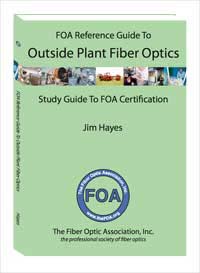
FOA
Reference Guide to Outside Plant Fiber Optics, Appendix B
- FOA
Online Guide Table of Contents
- Return
to The FOA Home Page
-
-
-
For
More Information, Contact The FOA:
-
-
-
Office
Hours 10AM-5 PM Pacific Time
-
Telephone:
760-451-3655
-
Fax:
781-207-2421
-
info@thefoa.org
(C)2021, The Fiber Optic Association, Inc.