- A
History of Cabling for Communications
- The
history of telecommunications spans slightly more than
150 years, starting with the development of the
telegraph in the early 19th century. Telegraphy gave man
the means to transmit a series of impulses that
represented letters, called Morse Code for Samuel F. B.
Morse, who is credited with the invention of telegraphy.
When these letters were received and decoded, they
provided a way to convey messages over long distances.
-
- Naturally,
the next step was to consider whether sound might also
somehow be electrically transmitted. Alexander Graham
Bell applied for his patent for an "electrical speaking
telephone" in 1876, beating Elisha Gray by only a few
hours. In reality, many people contributed to telephone
improvements including Thomas Alva Edison, Lars Ericsson
and David Edward Hughes whose invention of the
microphone became universally used in telephones.
-
- It
is amazing how quickly the use of the telephone spread.
The first switchboard, an experiment, was installed in
Boston in 1877. Just four years later, there were 54,000
telephones in the United States! The first connections
from Boston to New York begain in 1884. Wireless
communications developed from the work of Nikola Tesla
and Guglielmo Marconi. In the first decade of the 20th
century, Dr. Lee deForest's invention of the vacuum tube
amplifier enabled long distance communications.
-
- Technology
allowed the expansion of telecommunications. With the
advent of the space program in the 1960s, communications
satellites expanded the worldwide telecommunications
network faster than could be done by laying transoceanic
cables. By the 1970s, integrated circuit technogy and
the microprocessor began to influence telecommunications
and computers. Experiments began in digital voice
transmission and fiber optics. Computer networks like
Ethernet and the predecessor of the Internet were
developed.
-
- The
1980s brought wide scale use of digital telecom,
computer networks and fiber optics, but was also the era
of the breakup of the Bell system. Users who once
depended on AT&T for telecom standards and IBM or
other computer companies for the "rules" they depended
on were left stranded.
-
- Manufacturers
assumed responsibility for standards development to
ensure interoperability of their products - under the
auspices of the IEEE for computer networking electronics
and EIA/TIA for cabling in the US and ISO and IEC
worldwide. Thus was born the industry standards that we
all depend on for today's communications networks.
The 1990s to today are the era of computer LANs and the
Internet. Although not every proposed usage of cabling has
been successful, today every PC is connected to a LAN or the
Internet or both. Telephone systems are using VoIP (Voice
over Internet Protocol) over the Internet as well as
traditional telecom protocols, with wireless connection
being used in many cases instead of wiring. Internet access
over cell phones has added even more expansion to the
market. Perhaps the biggest change of the current era is the
final expansion of fiber optic networks direct to the
subscriber, either homes or business (FTTx),
using passive optical network (PON) technology.
But all telecommunications and the Internet depend on
cabling, even wireless. Typically it's all on a worldwide
fiber optic backbone connected into private networks that
utilize a combination of copper, fiber and wireless
connections.
Here
is a history of modern communications.
What is Premises Cabling?
By premises cabling, we mean the cabling used inside
buildings (and in restricted geographic areas like campuses
or among business facilities) that follows industry
standards. Mostly we are referring to structured cabling
systems defined by TIA-568 or ISO/IEC 11801 and
related standards that are used for LANs, telephone systems
and even other systems adapted to structured cabling like
CCTV, security or building management. Other systems that
depend on cabling such as security and building control are
migrating to structured cabling for its widespread
availability and predictability.
Other Uses For Standardized Premises Cabling
TIA-568 originally considered the use of structured cabling
to be corporate LANs, primarily Ethernet but some legacy IBM
Token Ring. However the large-scale adoption of UTP cabling
standards has gained the attention of many other
applications. UTP is now used for CCTV cameras, security
systems, building management systems, etc. Some of these
systems have been redesigned for UTP cable while others
require adapters, such as BALUNs which convert coax to
balanced UTP transmission. One can also get adapters that
allow multiple equipment to use separate pairs of the UTP
cable, for example for a POTS phone line and a Fast Ethernet
connection. Most of these applications will also use fiber
optics where the length or bandwidth exceeds the limitations
of UTP copper cable.
-
- What
Are Cabling Standards?
- Widespread
useage of any technology depends on the existence of
acceptable standards for components and systems. These
standards are written as minimum specifications for
components and systems that will ensure
interoperability of equipment from various
manufacturers. The most important "standard" and the
only one that is legally mandatory is the National
Electrical Code developed by the National Fire
Protection Assn. that covers all aspects of electrical
and fire safety. Article 800 of the NEC covers
communication circuits, such as telephone systems and
outside wiring for fire and burglar alarm systems and
Article 770 covers fiber optics. Also, all VDV wiring
must comply with building and electrical codes
applicable in your state or city.
-
- But
during the 1980s, technology changed rapidly. Phone
signals became digital, fiber proliferated, PCs became
connected over LANs and new cables and cabling
architecture were needed. The goal was to make buildings
"smart," able to allow computer and phone conversations
over a standardized wiring system. By the early 90s, a
scheme of "structured cabling" was standardized by
technical committee of a trade association, the merged
Electronic Industries Association and Telecommunications
Industry Association (hereafter referred to as EIA/TIA)
in the USA and ISO/IEC worldwide.
-
- This
cabling standard, developed by what was then called the
EIA/TIA TR 41.8 committee - now renamed TR 42 - is
referred to by the number of the primary standard,
EIA/TIA 568, although there are actually a number of
standards, technical advisories, etc. that cover all
aspects of structured cabling. When most people simply
say "568" when they mean the entire output of the TR 42
committee (see below.)
The model for premises cabling standards was AT&T’s
design guidelines for communications cabling developed
originally from a 1982 survey of 79 businesses located
in New York, California, Florida and Arkansas involving over
10,000 cable runs. At the time, cabling was used mainly for
telephones to wiring closets and PBXes (Private Branch
Exchanges or local phone switches), but it established a
baseline for cable length requirements for commercial
customers that was used in creating TIA-568. The
AT&T survey determined that 99.9% of all stations were
less than 300 feet (about 100 meters) from the wiring
closet, so that became the goal of the 568 standard. Much of
the terminology from the telephone industry also carried
over into the development of structured cabling standards,
although some of that terminology is being replaced by less
telephone-specific terminology.
Today's premises cabling standards define cabling systems,
using both copper and fiber optic cables, that can support
premises networks called LANs for "local area networks" from
10 megabits per second to 10 gigabits per second over 100
meter distances. Other premises systems such as building
management, HVAC, security systems including CCTV that
previously used coax cabling, etc. now are designed around
structured cabling standards.
Cabling standards are not developed for end users or
installers, but for component and equipment manufacturers
who need to develop products that offer interoperability
andthe mutliple sources of supply demanded by users. The
manufacturers develop products around the standards
specifications and are responsible for telling installers
and end users how to use these components. The designers,
installers and users of networks can rely on the
instructions of the manufacturers on how to utilize these
"standard products" correctly.
The essence of standards for structured cabling is they
provide a minimum performance level for components and
cabling systems that manufacturers use to develop products
for the marketplace. The competition in the cabling
marketplace requires companies to make cables that are
better than those standards in order to differentiate their
products from competitors. So using those standards,
manufacturers make cables that will be compatible with other
cables meeting the same standards but offer advantages in
performance, installation or cost.
-
- Many
people think this standard is a mandatory, even legal,
document like the NEC. In fact, "568" is a voluntary
interoperability standard for communications cabling,
developed by a number of manufacturers of cabling
components and networking equipment, so that they might
make equipment that could use any 568-compliant cabling
system and be upgraded in the future as long as it was
designed for the same cable plant. What 568 is, in
fact, is a common sense approach to cabling that defines
component and cabling system specifications and offers
interoperability, upgradability and low cost due to the
numerous manufacturers offering compatible
products.
-
- Note:
TIA-568 is a US standard. Worldwide, ISO/IEC 11801 is
the international standard. ISO/IEC writes these
standards and a summary of their standards is below.
- The
Basics of "568"
- The
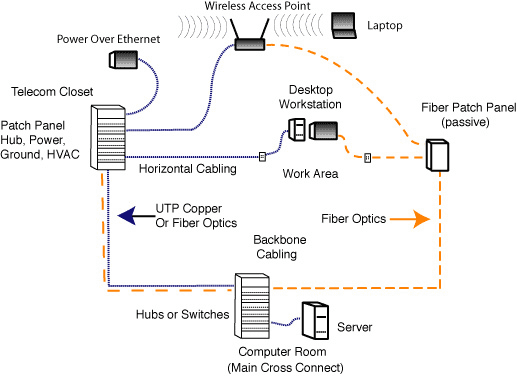
TIA "568" structured cabling standard calls for
connecting the desktop (work area) to a telecom closet
(the "horizontal" run) with up to 100 meters of cable
(including 90 m of permanently installed cable
(permanent link) and no more than 10 m total of
patchcords), which is usually unshielded twisted pair -
UTP - with 4 pairs of wires - called Cat 3, Cat 5,
Cat5e, Cat 6 or Cat 6A. The "Cat" or "category"
designation refers to a performance level or grade for
UTP cabling, which we will explain in the Cables
section. Most copper installations today use Cat 5e or
Cat 6 exclusively, as they aren't that much more
expensive than Cat 3 and can support phones or any LAN
on any outlet. Screened twisted pair (foil shielded over
the 4 pairs) and shielded twisted pair (STP) are also
acceptable and in fact widely used outside the USA.
-
-
- The
backbone cabling can be either UTP or fiber optics. In
larger networks, fiber is most often used for its longer
distance capability and higher bandwidth. 568 specifies
two multimode fibers, 62.5/125 - the most common MM
fiber until recently, and 50/125 - a higher bandwidth
fiber rated for use with lasers for gigabit networks
that is rapidly overtaking 62.5/125 in popularity.
Singlemode fiber is also specified for longer backbone
links, as in a campus, for high speed networks.
-
- Fiber
optics is also a horizontal option in 568, but not often
used because of the higher cost except where high
bitrate networks or future upgrades are expected.
However, a properly designed centralized fiber network
that connects the desktop directly to the computer room
with no intermediate electronics does not need a telecom
closet and saves the cost of conditioned power, data
ground, AC and the floor space, which may offset the
additional cost of the fiber electronics.
-
- Virtually
every corporate network now includes wireless, which is,
of course, not wireless since access points are
connected into the network with copper or fiber cabling.
Issues for wireless include proper siting of the
wireless access points (antennas, also abbreviated as
APs), providing adequate bandwidth to the access points
and ensuring network security since wireless signals are
easily intercepted.
- The
telecom closet, or telecom room (TR) as it is now
called, houses the hubs for the computers in the work
areas. These hubs are interconnected on "backbone"
wiring which is mostly fiber optics, as it usually
carries higher speed signals over longer distances and
provides isolation from ground loops, another problem
with copper cabling in LANs. The main cross-connect
(MXC) or equipment room contains the network and telco
hardware. For the telephones, their lower bandwidth
requirements allow longer runs, so they are usually
simply connected to backbone cables in the telecom
closet with a punchdown and run straight to the MXC.
-
- TIA
568 standards have also included IBM Type 1 cable, a
shielded two pair cable, since it is still used in some
networks. However, it does not include coax cable, like
RG-58 used in some Ethernet LANs and RG-6 used in CATV
and CCTV, except in the residential standard.
A general restriction for structured cabling is the
permissible distances for cable runs. The table below lists
cable distances for various types of permitted cabling. The
restrictions on fiber links in the horizontal are arbitrary
to be equal to copper cabling and may be exceeded for many
network uses as long as the equipment provider allows such
use. Fiber lengths in the backbone may be restricted by the
bandwidth of multimode fiber when used with high speed
networks, so the choice of fiber type may determine the
actual length possible.
| Cable
Type |
Distance
(Meters) |
Distance
(Feet) |
| UTP
copper (data) |
100 |
330 |
| UTP
copper (voice-POTS) |
800 |
2625 |
| DSL/ADSL |
5000 |
16404 |
| MM
fiber (horizontal) |
100 |
330 |
| MM
fiber (centralized) |
300 |
1000 |
| MM
fiber (backbone) |
2000 |
6560 |
| SM
fiber (backbone) |
3000 |
9840 |
TIA-568-C revision changed the nomenclature of structured
cabling systems. Here
is an explanation of the change.
-
- Beyond
"568"
- 568
is only part of the structured cabling standards. It's a
multi-part standard itself and there are several more
standards cover other areas of cabling:
- EIA/TIA
568: The main standard document for structured cabling,
usually referred to as simply "568." Always check with
manufacturers for the latest revisions.
- EIA/TIA
569: Covers pathways and spaces. Defines the "telecom
closet" or telecom room as it is now called.
- EIA/TIA
570: Residential cabling.
- EIA/TIA
606: Cabling system administration (documentation)
- EIA/TIA
607: Grounding and bonding
-
-
- International
Standards
- The
international equivalent of EIA/TIA 568 which came later
and basically copied 568 is ISO/IEC 11801. The standards
are written similarly to what has been done by TR 42.
Here are their relevant standards:
- ISO/IEC
11801 - Cabling for customer premises - structured
cabling similar to TIA 568
ISO/IEC 14763-1 - Administration, documentation -
similar to TIA 606
ISO/IEC 14763-2 - Planning and Installation - similar to
TIA 569
ISO/IEC 14763-3 - Testing optical fibre cabling -
included in TIA 568
IEC 61935-1 - Testing copper cabling - included in TIA
568
Electrical Codes For Cabling
The most important "standards" and the only ones that are
legally mandatory are the local building and
electrical codes, such as the US National Electrical Code
(NEC.) The NEC is developed by the National Fire Protection
Assn. and covers all aspects of electrical and fire safety.
Article 800 of the NEC covers communication circuits, such
as telephone systems and outside wiring for fire and burglar
alarm systems and Article 770 covers fiber optics. All
premises cabling must comply with building and electrical
codes applicable in your area. Below is a listing of current
NEC articles covering premises cabling.
NEC Articles Covering Cabling (US)
| Chapter
|
Article
|
Topic |
| 6
|
640
|
Sound
Systems |
| 7
|
725
|
Remote-Control,
Signaling and Power-Limited Circuits |
| 7
|
760
|
Fire
Alarm Signaling Systems |
| 7
|
770
|
Optical
Fiber Cables and Raceways |
| 7
|
780
|
"Smart
House" Wiring |
| 8
|
800
|
Telecommunications
Circuits (Telephone and LAN) |
| 8
|
810
|
Radio
and TV Equipment |
| 8
|
820
|
CATV
Systems |
| 8
|
830
|
Network-Powered
Broadband Systems |
Learning More About Standards and Codes
There are a number of ways of finding out more about cabling
standards. You can buy a complete copy of the EIA/TIA or
ISO/IEC standards which can be very expensive and wade
through page after page of standards language. You can also
get catalogs and/or visit the websites of a number of
cabling manufacturers who have extremely complete
explanations of the standards which have been created for
their installers and end users. The second method is the
recommended one.
Understanding codes requires not only learning what codes
cover but what codes are applicable in the local area and
who inspects installations. Furthermore, codes change
regularly, usually every 2-5 years, and installers are
required to keep up to date on the codes. Understand what is
required in the areas you do installations and know when the
codes are updated.
- The
"Cables" of "Cabling"
- The
choice of cable in network cabling (or
communication medium as it is sometimes called) is
rather important because of the extremely high
frequencies of the signals. Sending a 60-cycle utility
power through a wire rarely presents a difficulty; but
sending a 1 or 10 billion bits per second signal can be
a lot more difficult. For this reason, the method of
sending signals and the materials they are sent through
can be important.
-
-
- Network
Cabling Types
- A
number of cabling options have been developed over the
history of communications and are still in use for
networking connections.
-
- Unshielded
Twisted pair (UTP) - UTP cable is the primary cable used
for networks, as specified in the EIA/TIA 568 standard.
UTP was developed from the original phone wires but
refined to enhance its bandwidth capability. This cable
type has been widely used because it is inexpensive and
simple to install. The limited bandwidth of early UTP
(which translates into slower transmissions) has pushed
development of new cable performance grades (the
"categories" of 568) but has created a more expensive
product and more complicated installation process.
-
- Screened
Twisted pair (ScTP) - Same as UTP with an overall shield
around the 4 pairs. While not currently specified for
any networks or covered in the EIA/TIA 568 standard (but
not prohibited), it is used in many networks in Europe
where EMI is a greater concern. It tends to be more
expensive, harder to terminate and requires special
shielded plugs and jacks.
-
- Shielded
Twisted Pair (STP) - Like UTP but with a shield around
every pair. Widely used in IBM systems (IBM Type 1
cable) and included in early versions of 568.
-
- Coaxial
Cables - The original Ethernet cable was coax and
coax is still used in video (CCTV, CATV) systems. This
is familiar and easy to install, has good bandwidth and
lower attenuation but more expensive and bulky. Not
included in 568, but in 570 for residential video use.
Coax is also used in residential applications for LANs
using a transmission scheme called MoCA that works like
a cable modem. Read
more on coax.
-
- Optical
Fiber - Optional for most networks, top performance,
excellent bandwidth, very long life span, excellent
security but slightlly higher installed cost than
twisted pair cables, more expensive electronics
interface to them. Fiber can be cost efffective with
optimal architecture. See FIber
in Premises Cabling and the FOA
Online Guide Table of Contents .
-
- Other
Transmission Options
- Wireless
- no data transmission cables are required to connect
any individual terminal, but wireless requires cabling
to every antenna (called an Access Point.) Within the
range of the radio signals, a terminal can be moved
anywhere. Usually wireless is more expensive but can be
used in locations where is would be difficult to install
cables. In the modern network, wireless is a requirement
because so many users want "mobility" - so they are not
"tethered" to a desktop. More
on wireless.
-
- Infrared
Transmission - Also transmits data without wires or
fibers using infrared (IR) light but each transmitter
requires cabling. By sending pulses of infrared light in
the same patterns as electronic pulses sent over cables,
it is possible to send data from one place to another.
Networks based on IR transmission have been developed
for use in office and for line-of-sight transmissions
between buildings. It is generally limited in range and
can be interrupted by blocking or weather.
-
- Powerline
or Phone Line Transmission - Networks using available
power line cabling have been under development for many
years, but with mixed results due the
unpredictability of wiring performance and interference
from power line noise.
-
We
will focus only on the most popular types of cabling, UTP,
coax and fiber optics, as well as cabling for wireless.
Test
your comprehension with the section quiz.
Premises
Cabling Website Contents
Each page will open in a new window
Overview
of Premises Cabling and Standards
Jargon
Networks
UTP
Cables
UTP
Terminations, (Tutorial).
UTP
Termination.
UTP
Installation VHO 66
Block, 110
Block, Jacks,
Plugs
UTP
Testing, UTP
Wiremapping
Coax
Cable VHO Coax
Termination
Fiber
Optics in Premises Cabling
Wireless
Design,
New T-568-C
Nomenclature
Premises
Cabling Installation
Glossary
Table
of Contents: The FOA Guide
|