Unshielded
Twisted Pair (UTP) Cable
- Because
networking
evolved over several decades, many different cabling
solutions have been used. But today, virtually all VDV
copper cabling in the US has moved to unshielded twisted
pair (UTP) as specified in the EIA/TIA 568 standard (ISO/IEC
11801 worldwide) because it has been inexpensive, may
already be in place, is familiar to installers and is simple
to install. (The cost and simplicity of installation has
changed a bit, however, with Cat 5e/6/6A, see below.) Some
users, mostly outside the US, use shielded twisted pair
(STP) with shields over each pair in the cable or screened
twisted pair (ScTP) with an overall shield around all the
pairs. These cables can provide higher performance but
require more care in installation.
UTP
cable has been a standard cable for telephone systems for almost
a century, where it is generally used for analog phone systems
(POTS or plain old telephone service.) These cables are
generally large multipair cables with pair-count configurations
of 25, 50, 100, 200 pairs or more.
-
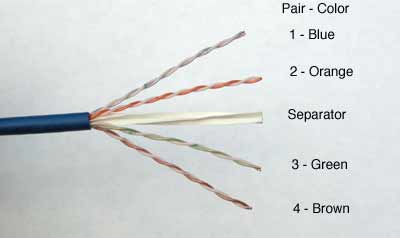
- Most
UTP
cable used in structured cabling systems today is comprised
of four pairs of carefully twisted pairs of solid copper
wire, insulated with carefully chosen material to provide
high bandwidth, low attenuation and crosstalk. Cables
permanently installed in premises cabling systems use solid
wire for higher performance but patchcords generally use
stranded wire for greater flexibility and ruggedness when
handled.
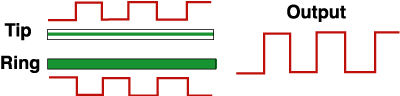
- UTP
cable works so well because it is used with transmitters
that work on "balanced transmission" as shown below. They
transmit equal but opposite signals on each wire of the pair
so each wire has only half the amplitude of the final
signal. The electrical and magnetic fields of each wire are
opposite and cancel out eachother, producing low
electromagnetic emissions. Likewise, electromagnetic pickup
is the same on both wires so they cancel out. The twists on
the pair of wires mixes the emissions from the electrical
signals so they cancel out.
-
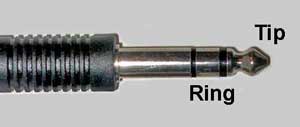
Twisted Pair Trivia: The two wires are referred to as
"tip" and "ring" - but why? Does it have something to do with
the ringer on a phone? No! It refers to the connection on a old
phone plug from manual switchboards. The white/stripe wire was
connected to the "tip" of the plug and the solid wire to the
"ring" connector behind it!
-
- The
secret
ingredient of Cat 5e/6 is the twists of the pairs! Below,
you can see the difference in the twists in each pair for
different types of cables. From the left, we have telephone
wire with hardly any twists in the pairs, then Category 3,
Category 5e and Category 6 cables, with each higher grade
having more tightly twisted pairs. The Cat 6 cable even has
a separator between the pairs to reduce crosstalk at the
higher frequencies where it will be used.
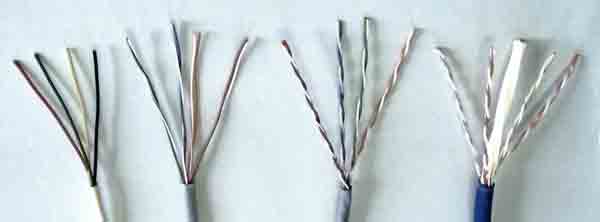 POTS, Cat 3, Cat 5, Cat 6A
- The
pairs are twisted tightly and very consistently, but each
pair is twisted at a different rate to "tune" them to
different frequencies to prevent crosstalk between the
pairs. In order to maintain Cat 5e/6/6A performance,
especially crosstalk, you absolutely must keep the twists as
close as possible to the terminations- no more than 1/2 inch
- 13 mm should be untwisted!
- UTP
cable is terminated mostly in jacks, connector receptacles
that have punchdown terminations on the backside and twists
in the connectors inside to prevent crosstalk. See
Terminations. Some snap into work area outlets, others
are incorporated in rack mount patch panels. 568 allows many
possible cable configurations, including intermediate
punchdowns, but a direct run from a work area outlet to a
patch panel will provide the highest performance, likely
necessary if upgrades to fast networks like Gigabit Ethernet
are contemplated.
-
- Patchcords
for connecting network equipment to the outlet or patchpanel
are usually purchased factory-assembled. The connector
(plug) is properly called a "modular 8 pin connector" but
usually is referred to as a RJ-45, which is actually a
specific telco pin configuration on the same plug. They use
stranded cable for flexibility and require special
connectors. Order them to proper length if you can to
prevent the mess that patch panels often become after a few
moves and changes.
Performance Grades
- Higher
performance
UTP cables were developed as computer network speeds
increased and needed higher bandwidth cables. The first
graded cable, Cat 3 was adequate for 10 Megabits/s Ethernet
or 4 Mb/s Token Ring. Token ring at 16 Mb/s required higher
performance cable, so Cat 4 was introduced, but neither
network nor cable grade lasted long. Instead Cat 5 was
introduced to support "Fast Ethernet" at 100 Mb/s.
- When
Ethernet was upgraded to 1 gigabit per second (1000 Mb/s) ,
Cat 5 was upgraded to "enhanced" Cat 5 or Cat 5e. Cat 6 was
developed by cable manufacturers as a higher performance
cable with more headroom, but no network was ever specified
to use it. Instead, when 10 Gb/s Ethernet was developed, an
"augmented" Cat 6, Cat 6A, was required. TIA has recently
approved a new shielded cable for short (30m) data center
connections at 10-25Gb/s called Cat 8.
In Europe,
a shielded twisted pair (STP) cable, Class F is used. Some US
manufacturers offer a version of this cable they call "Cat 7"
but TIA has not considered this cable part of TIA-568, so "Cat
7" is not its proper nomenclature.
- You
can get hardware and cable rated for many different
performance grades. With cable, it's easy to see the
difference; it's in the twists - higher performance cables
have more twists. But jacks are harder to tell the
differences. But they are different - inside jacks rated Cat
5 or above you will find internal twists to reduce
crosstalk. If you terminate Cat 5e cable with Cat 3 jacks,
you will get Cat 3 performance - no better! When dealing
with high performance UTP cabling like Category 5e, Cat 6
and Cat 6A designed to support Gigabit Ethernet or faster,
termination procedures become even more complicated! It's
vitally important to ensure all components are rated to the
same high level in order to achieve that performance level.
Instead
of the "Categories" used in the US, in Europe and much
of the rest of the world they use "Classes" to designate
performance. Here's a table of performance and correllations
to US standards. (Remember these are the standards which
specify minimum performance, so many manufacturers will offer
cables with frequency performance greater than the standards
for competitive reasons.)
| ISO/IEC
Class |
US
Category |
Frequency
(MHz) |
|
A |
|
0.1 |
|
B |
|
1 |
|
C |
3 |
16 |
|
D |
5e |
100 |
|
E |
6 (6A) |
250 (500) |
|
F |
-
7
-
(Not
currently under consideration)
|
600 |
I,
II
|
Cat
8
|
2000
(30m)
|
-
- Here's
a guide to the differences in the categories.
-
-
|
Characteristic
EIA/TIA(ISO)
|
Cat
5 |
-
Cat
5e
-
(Class
D)
|
-
Cat
6 (6A)
-
(Class
E)
|
-
"Cat7"
-
(Class
F)
|
Cat
8
(Class I, II)
|
| Supports
networks |
100Base-T |
1000Base-T |
-
1000Base-T
-
(10Gbase-T)
|
-
?
-
None
currently considered
|
-
10-40 Gb/s
|
| Test
Frequency |
100
MHz |
100MHz |
250
MHz
(500 MHz) |
600
MHz |
Terahertz |
| Length |
100
meters |
100
meters |
100
meters |
100
meters |
30
meters
|
| RJ-45
Compatible |
yes |
yes |
-
yes
|
No |
Some |
| Field
Tester Requirement: |
Level
2 |
Level
2e |
Level
3 (3e) |
Level
4
|
Level
2G
|
-
-
- Like
everything
else that deals with computers and communications, the speed
of networks is going up. Cat 5e is OK to handle one gigabit
networks, but the EIA/TIA TR 42 committee that writes the
cabling standards (the same "568" we referred to earlier)
approved the standard for Cat 6 cabling in June of 2002
after three years of debate, discussion and testing.
Unfortunately, network speeds jumped to 10 Gigabits/second,
requiring another redesign, leading to "augmented Cat 6" or
Cat 6A.
-
- each
new standard includes cables, plugs and jack, patch panels
and patch cords, in other words, everything you need to
install a complete cabling system. Performance
specifications for Cat 6A are for significant advances over
Cat 6 or Cat 5e - with attenuation and crosstalk performance
higher at every level.
-
- So
using higher rated cables give you more "headroom" - better
signal to noise ratios - which can mean more robust data
transmission on slower Fast Ethernet and Gigabit Ethernet
(1000base-T) networks.
-
-
Cat
6 was not associated with the requirements of any particular
network, but many people installed it as a higher
performance cable than Cat 5e. Gigabit Ethernet ran fine on
Cat 5e (some manufacturers say it runs well on Cat 5 now)
and when 10 Gigabit Ethernet came along, it could initially
only run on fiber optics. The copper manufacturers developed
an "augmented" Cat 6 specified for 10GbE. Cat 6A introduced
a new performance issue, not within the cable itself, but in
crosstalk with adjacent cables, called "alien" crosstalk.
The power consumed by Cat 6A transceivers to send such high
speed signals over copper was higher than fiber due to the
signal processing needed for faster electrical connections.
Fiber remains the most reliable solution for GbE and above.
Years
later, wireless access point providers, needing more than
1Gb/s speeds, developed 2.5 and 5G Ethernet electronics that
would operate over Cat 5e cable, allowing wireless network
updates over legacy cabling. These networks were later
standardized by the Ethernet committee.
- This
leap in technological advances, like all previous ones,
comes with a cost. The goal of the committee is that each
generation of Category-rated cable be "backward compatible"
which means that any networking product that works on Cat 3,
5 or 5e is supposed to work on Cat 6. The other issue that
the group wrestles with is "interoperability" - mixing and
matching components. This part of the standard states that
cable plant containing mixed categories (eg: Cat 5e
patchcords on a Cat 6 cabling systems) is supposed to work
without compatibility issues, but will only work at the
level of the minimum component specification (Cat 5e in this
case).
-
- Finally,
there is the issue of compatibility among different
manufacturers products. Practically everybody told users
installing "pre-standard" Cat 6 to stick to one
manufacturer's products or those tested for compatibility.
The EIA/TIA press release on the Cat 6 standard stated: "To
ensure generic cabling system performance, Category 6
component requirements are specified to be interoperable
when products from different manufacturers are mated". The
same issue probably exists with Cat 6A.
The
highest performance Category-rated cable is Category 8,
ISO/IEC Class I and II depending on connector types used. Cat
8 is a shielded cable designed for networks in the 10-40G
range, especially for use with short connections between
servers and switches in data centers. It is limited to 30m
length, adequate for typical data center top-of-rack or
end-of-row architectures.
-
- Screened
(ScTP) and shielded Twisted Pair (STP)
- Outside
the US many countries, especially the Europeans, use Class F
- a shielded 600 MHz cabling system, which the EIA/TIA TR42
committee has declined to consider such a standard in the US
due to lack of interest from the network development
committees.
Internationally,
ScTP
and STP cable is much more common, as concerns over
electromagnetic interference have affected standards more than
in the US. ScTP cable is simply a UTP cable with a metallic foil
shield over all 4 twisted pairs. Some manufacturers also call it
FTP for foil-shielded twisted pair. The foil shield is for noise
immunity, keeping outside noise out of the pairs and keeping
emissions from the pairs themselves from escaping the cable.
ScTP is not the same as shielded twisted pair which has a foil
shield over each individual pair and may also have a shield over
all the shielded pairs under the cable jacket.
Current ScTP cables are smaller than most UTP cables that are
rated as Cat 6A (augmented Category 6). The problems of
crosstalk between pairs in two separate cables that affects Cat
6A, called alien crosstalk, is negated by the foil shield of
ScTP. For UTP Cat 6A cables, the solution to alien crosstalk was
bigger cables with thicker jackets, causing problems with the
number of cables that could be accommodated in conduits and
cable trays. ScTP Cat 6A cables are no larger than Cat 6 UTP
cables, making them easier to fit in current cabling hardware.
For termination, ScTP cables use shielded modular 8-pin
connectors just like UTP but with a shield. Terminating the
shield is pretty simple, just like adding a 9th wire to the
cable. One does have to worry about grounding, as ScTP cable
must be tied into the grounding busbar in the telecom room along
with all the racks and other metallic hardware.
The extra conductor in the cable offers another benefit. It can
be used for cable management systems where it allows tracking
cable connections using add-on electronic equipment that
automates the most time consuming part of any cabling project –
keeping documentation up to date.
Single Pair Ethernet
Single Pair
Ethernet: IEEE has created a standard primarily for industrial
Ethernet that uses a single pair cable for 10, 100 or 1000Mb/s
networks. It uses a different style of cable and connector for
rugged environments. A special power-over-Ethernet standard has
been developed for it
called PDL - power over data line.
- Cable
Listings For Flammability
All cables
installed inside buildings must meet flammability requirements
of the building and electrical codes, which in the US means the
NEC (National Electrical Code) or CEC in Canada.
Communications cable will be rated per the following table,
depending on its use.
| Cable
Designation |
Application |
| CMX |
General
use for dwellings and raceways |
| CMR |
Riser
rated for use in vertical shafts, rated to prevent
carrying fire from floor to floor |
| CMP |
Plenum
rated for use in environmental air spaces such as
dropped ceiling spaces used for air return |
- CATV
cable (CATV) and multipurpose cable (MP) are also covered
under other sections of the electrical codes.
-
- Network
Cable Handling
- The
performance of the cabling network is heavily dependent on
the quality of the installation. The components used in
structured cabling installation have been carefully designed
and exhaustively tested to meet or esceed the requirements
of EIA/TIA 568 for performance at 100 MHz. If the cable is
not properly installed, performance will be degraded. In
particular, one should avoid bending the cable too tightly,
kinking it or using tightly installed cable ties which can
crush the cables. Loosely bundling cables with "hook and
loop" cable ties is much better. See installation
for more tips.
Test
your comprehension with the section quiz.
Premises
Cabling Website Contents
Each page will open in a new window.
Overview
of Premises Cabling and Standards
Jargon
Networks
UTP
Cables, Power Over
Ethernet.
UTP
Terminations, (Tutorial) UTP
Termination.
UTP
Installation VHO 66
Block, 110
Block, Jacks,
Plugs
UTP
Testing, UTP
Wiremapping
Coax
Cable VHO Coax
Termination
Fiber
Optics in Premises Cabling
Wireless
Design,
New T-568-C
Nomenclature
Premises
Cabling Installation
Glossary
See
the "Fiber Optic
Technology and Standards" Section below for information
on networks, etc.
FOA
Lectures on Premises Cabling and videos about cable
preparation, termination, splicing and testing on 
|