Testing
UTP Cabling
- Since
Cat 5e/6/6A UTP cable is used to the fullest extent of its
performance envelope, comprehensive performance testing is
very important. There are three basic tests that are
called for as part of the EIA/TIA-568 specs for all UTP
cables: wiremap, length and high speed performance. We'll
take a look at each of them and equipment needed to test
them.
-
- What
Is A "Certified" Cable?
-
- Certification
has been used by vendors of testers to mean that the cable
was tested and passed by one of the Cat 5e/6/6A
"certification" testers which test all the standard's
specified performance parameters. It means that the
cabling meets the minimum specifications of EIA/TIA
standards and should work with any network designed to
operate on a Cat 5e/6 link.
Thus, a
"certification tester" or "certifier" is an instrument that
tests the cabling and compares it to the TIA-568 or ISO/IEC
11801 standards, certifying that the cable meets the minimum
performance specifications required by the standard.
-
- What
is "Verification"?
-
- Alternatively,
cable may be tested to determine if it will carry the
network signals intended for use on the cabling systems.
These testers run network bit error rate tests (BERT) over
the cable as well as checking wiremap and length. A "cable
verifier" will guarantee the cabling will support Gigabit
Ethernet, for example, but does not test to the TIA
cabling standards, only a problem if some other system,
such as analog video, may be used.
-
- Wiremap
- All
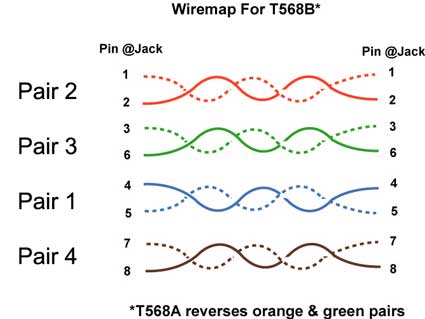
testers test Wiremap. Wiremapping
is a simple test that confirms that each wire is
hooked up correctly, with no opens or shorts. UTP intended
only for POTS (plain old telephone service) voice
applications actually only needs to be tested for wiremap.
Wiremapping is very straightforward. Structured cabling
standards do not consider simple voice grade cable, only
cable of Category 3 or above, so most cable testing will
require more than just wiremapping. Each pair must be
connected to the correct pins at the plugs and jacks, with
good contacts in the terminations. A "wiremapper" is
basically a continuity checker that determines if pins are
correctly connected.
-
-
- Most
of the failures are simple enough to understand, like
reversed wires in a pair, crossed pairs, opens or shorts.
One possible failure, crossed pairs, is caused when both
wires of a pair are crossed at one termination. The usual
cause of a crossed pair is a 568A termination on one end
and a 568B on the other.
-
- The
most difficult wiremap problem is a split pair, when one
wire on each pair is reversed on both ends. It causes the
signal to be sent on one wire each of two pairs. The usual
DC wiremap will pass but crosstalk will fail. It takes a
more sophisticated wiremapper or Cat 5e/6/6a tester to
find a split pair, as some wiremapp testers which use only
DC tests do not check crosstalk. In our experience, a
split pair is usually caused by someone using punchdown
color codes on jacks which splits the pairs.
More
information on wiremap testing and troubleshooting.
-
- Length
-
- Since
568
cables must be less than 90 meters (296 feet) in the
permanent link and 100 meters in the channel (328 feet),
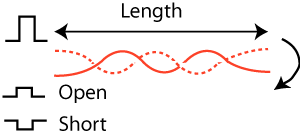
cable length must be tested. This is done with a "time
domain reflectometer" (TDR) which is a cable "radar". The
tester sends out a pulse, waits for a reflection from the
far end and measures the time it took for the trip.
Knowing the speed of the pulse in the cable (calibrated
for various cable types), it calculates the length. All
cable certification or verification testers include a TDR
to measure length.
-
- Besides
measuring
length, the TDR looks at the polarity of reflected pulses
to find shorts or opens. If you have a short or open, the
TDR will tell you what and where the problem is by looking
at the return pulse, making it a great tool for
troubleshooting problems. If the return pulse is the same
polarity, the cable is open. If the pulse is of opposite
polarity, the cable is shorted. If no return pulse is
seen, the cable is terminated at its characteristic
impedance.
Performance Testing For Certification
Performance testing for attenuation, crosstalk, etc. requires
testing over the full frequency range of the cable which
depends on the cable type. The
specifications including frequency range for each cable type
is:
|
Characteristic
EIA/TIA(ISO)
|
Cat
5 |
-
Cat
5e
-
(Class
D)
|
-
Cat
6 (6A)
-
(Class
E)
|
-
"Cat7"
-
(Class
F)
|
Cat
8
(Class I, II)
|
| Test
Frequency |
100
MHz |
100MHz |
250
MHz
(500 MHz) |
600
MHz |
Terahertz |
| Length |
100
meters |
100
meters |
100
meters |
100
meters |
30
meters
|
| RJ-45
Compatible |
yes |
yes |
-
yes
|
No |
Some |
| Field
Tester Requirement: |
Level
2 |
Level
2e |
Level
3 (3e) |
Level
4
|
Level
2G
|
The requirements for each field tester shown
-
- Attenuation
-
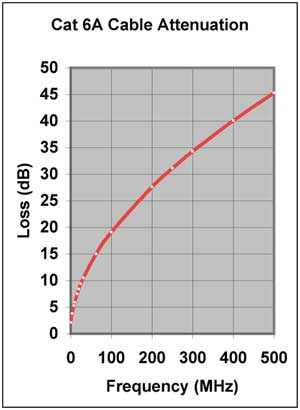
- The
proper operation of a LAN on the cable plant requires the
signal strength be high enough at the receiver end. Thus
the attenuation of the cable is very important. Since LANs
send high speed signals through the cable and the
attenuation of the cable is variable with the frequency of
the signal, certification testers test attenuation at many
frequencies specified in the 568 specs.

-
-
- This
test requires a tester at each end of the cable, one to
send and one to receive, then one of them will calculate
the loss and record it. There are pass fail criteria for
the cable at Cat 3, 4, 5, 5e, 6 and 6A max frequencies.
Here is how a typical cable attenuation changes with
frequency.
-
-
- Crosstalk
(NEXT)
-
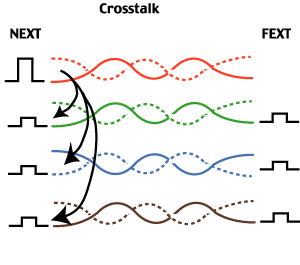
- It's
called NEXT for "near end cross talk" since it measures
the crosstalk (signal coupled from one pair to another) at
the end where one pair is transmitting (so the transmitted
signal is largest causing the most crosstalk.) Crosstalk
is minimized by the twists in the cable, with different
twist rates causing each pair to be antennas sensitive to
different frequencies and hopefully not picking up the
signals from it's neighboring pairs. Remember what we've
said repeatedly: you MUST keep the twists as close to the
terminations as possible to minimize crosstalk.
-
-
- Cat
5e /6 testers measure crosstalk from one pair to all three
other pairs for each pair and compare it to the 568 specs,
giving a pass/fail result. Some also calculate "ACR" or
attenuation/crosstalk ratio, as it is a measure of how big
the crosstalk signal is to the attenuated signal at the
receiver. You want this number as big as possible, as it
is an indication of the signal to noise ratio.
-
-
- Tests
on Cat 5e/6 for Gigabit Ethernet
-
- The
additional test specs for Category 5e and 6 includes a
number of new tests to insure higher performance from the
cable to make it compatible with Gigabit Ethernet. These
tests relate to higher bandwidth usage of the cable and
simultaneous use of all four pairs in both directions at
once.
-
- Powersum
Crosstalk (NEXT) is the NEXT on one pair when all three
others are carrying signals. This is realistic with
1000Base-T Gigabit Ethernet where all pairs carry signals
simultaneously.
-
- Far
end crosstalk, looking at the effect of the coupling from
one pair to another over the entire length, measured at
the far end. As tested, it's ELFEXT or equal level FEXT,
or the ratio of FEXT to attenuation, similar to ACR.
-
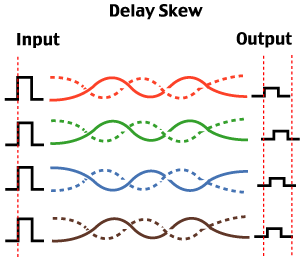
- Delay
Skew measures how much simultaneous pulses on all 4 pairs
spread out at the far end. This measures the speed on each
pair, which may be different due to the variations in
number of twists (more twists means longer wires) or
insulation. Since 1000Base-T Gigabit Ethernet uses all 4
pairs with the signals split into 4 separate signals, it's
necesary to have all arrive simultaneously. Testers
measure Propogation Delay, the actual transit time on the
pairs to calculate Delay Skew.
-
-
- Return
Loss is a measure of the reflections from the cable due to
variations in the impedance. These reflections can cause
signal degradation, especially if the pairs are used in a
full-duplex (bidirectional) mode. With 1000Base-T Gigabit
Ethernet transmitting in both directions on each pair,
return loss can cause big problems.
Requirements For Testing Cat 6/6A For 10Gigabit Ethernet
The development of augmented Cat 6 (Cat 6a) cable for use on
10 Gigabit Ethernet links added a new test. The cable is so
precisely made, especially the rate of twist in the pairs,
that cable pairs can interfere with the same pair in other
cables nearby. This added a new test for Cat 6A which is
called "Alien Crosstalk."
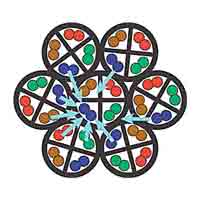
Performing this test is time consuming and is highly dependent
on the physical location of cables. Some controversy regarding
the relevance of this test exists in the industry, with some
cabling vendors not requiring it.
- Cable
Testers
-
- Wiremappers
test
the connections and Cat 5e/6 certification testers test
the performance at high frequencies. Cable Certifiers test
the cable according to TIA-568 standards. Cable Verifiers
test the cable to see if it will transmit Ethernet signals
without errors.
- Cable
Certification testers are mostly automated, "push a button
get a pass/fail" simple. Certification testers test
everything, wiremap, length, attenuation and crosstalk in
one connection, give you a pass/fail result, help on
troubleshooting and store the result for printing reports
for the customer.
-
- Some
installers use the certification tester for all testing,
after the cable is installed. But it's a very expensive
unit that needs a trained operator and many failures are
simply wire map problems. Others have each crew use an
inexpensive wiremapper to make sure all connections are
correct before the certification tester is brought in. By
having each crew find and fix their own wiremap problems,
testing and corrections are done as the cable is installed
and the cost of the certification tester is not wasted on
simple problems. It's just provides the high frequency
tests and documentation required by most users.
Cable Verifiers are a new class of testers that use the
Ethernet communications protocols to ensure the cable supports
the system intended for use on it, generally a LAN or
connection to a wireless access point.
Since some UTP cables are used for non-Ethernet applications
like CCTV, security or building management systems that are
designed to operate on TIA-568 standardized cabling, a
certification tester may be a better choice for them.
-
-
- Permanent
Link Adapters
-
- The
tester's adapter interface cable may be the weakest link
when testing. Conventional adapter cords may be the cause
for many false failures in the field. Susceptable to the
daily wear and tear associated with rough field
conditions, they degrade with time and contribute to
return loss, crosstalk and attenuation.
-
- Until
now, each tester used personality modules specific to each
manufacturer's Cat 6/6a cabling for testing. The
personallity modules insured that the connection between
the adapter and the link under test yield optimum
performance and more valid tests.
-
-
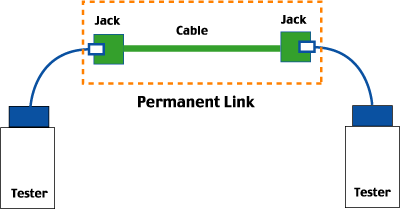
- A
change in the definition of the "link" was implemented in
EIA/TIA568 B and ISO 11801 AM2 and it is now called the
"permanent link." The permanent link moves the test
reference point to the end of the test cable at the wall
outlet or patch panel jack, including only the connector
on the end of the tester interface cable.
-
- Test
your comprehension with the section quiz.
Premises
Cabling Website Contents
Each page will open in a new window.
Overview
of Premises Cabling and Standards
Jargon
Networks
UTP
Cables, Power Over
Ethernet.
UTP
Terminations, (Tutorial).
UTP
Termination.
UTP
Installation VHO 66
Block, 110
Block, Jacks,
Plugs
UTP
Testing, UTP
Wiremapping
Coax
Cable VHO Coax
Termination
Fiber
Optics in Premises Cabling
Wireless
Design,
New T-568-C
Nomenclature
Premises
Cabling Installation
Glossary
See
the "Fiber Optic
Technology and Standards" Section below for
information on networks, etc.
FOA
Lectures on Premises Cabling and videos about cable
preparation, termination, splicing and testing on 
|