CFOT® -
Certified Fiber Optic Technician - is the primary FOA
certification for all fiber optic technicians. CFOTs have a
broad knowledge, skills and abilities (KSAs) in fiber optics
that can be applied to almost any job - design, installation,
operation – and for almost any application using fiber optic
communications.
Prerequisites: None, online course Fiber
U Basic Fiber Optics recommended
for all students to prepare for the classroom courses or direct
exam
What To Expect In Training Programs For CFOT Certification
To qualify for CFOT® Certified Fiber Optic Technician
certification, a training program will cover at least the
following topics:
Overview
of fiber optic applications and installations
Communications
systems utilizing fiber optics
Fiber
optic components appropriate for fiber optic networks
Installation
of premises and outside plant fiber optic cable
Splicing
and termination
Testing
fiber optic components and cable plants
Hands-On
Lab Exercises including hands-on splicing, termination and
testing
Typical Field Experience For Direct CFOT Certification (Work to
Cert)
- To
qualify for the CFOT certification, at least two years of
relevant field experience is required, including
documented experience installing and testing fiber optic
networks. Training by employers, manufacturers or vendors of
cabling products may be recognized as part of the experience
requirements.
Field
experience installing and testing fiber optic networks must
include the following:
- Participation
in multiple installation jobs, preferably including premises
and OSP installations
- Experience
preparing various cable types
- Experience
with fusion splicing and several termination types
- Experience
testing with visual inspection, VFL, OLTS, OTDR
What To Study To Prepare For The Exam
For
preparation for the CFOT course or direct exam, you should take
the Fiber
U Basic Fiber Optics course.
- CFOT® -
Certified Fiber Optic Technician - is the primary FOA
certification for all fiber optics applications. CFOTs have
appropriate knowledge, skills and abilities (KSAs)
in fiber optics that can be applied to almost any job -
design, installation, operation - for almost any application -
outside plant, premises, manufacturing, etc.
FOA CFOT certification is
based on an extensive knowledge of fiber optics technology and
application as well as demonstrated skills in appropriate
tasks. Most CFOTs work in the industry as contractors or
installers. Consultants, network designers, estimators and
trainers would also be expected to have such credentials.
CFOTs are also involved with the manufacture of fiber optic
components such as cables, patchcords, active devices and
communications systems.
However, the CFOT certification has been structured as a general
technology certification, not aligned to any specific job
function. It is used by all installers, both outside
plant and premises installers, two very different applications,
plus component manufacturing technicians, network managers,
network designers, etc. A well-prepared fiber optic technician
will have a CFOT plus appropriate specialist certifications (CFOS)
for the skills needed for the job (OSP, spicing, connectors,
testing, design, etc.) and applications (FTTH, OLAN, Wireless,
etc.)
The FOA also offers certification in premises cabling (CPCT,)
which also includes copper wiring and wireless.
The FOA CFOT certification requires a test of the applicant's
knowledge of fiber optics in a broad-based exam that covers
technology, components, installation and testing and also requires
verified skills and/or experience in fiber optics.
We call these the KSA - knowledge, skills and abilities. KSAs
for the CFOT certification.
It's CFOT® The
FOA CFOT®
(Certified Fiber Optic Technician) is a
registered trademark.
-
-
- How
Does One Qualify for the FOA CFOT?
FOA CFOT certification
means the person with a CFOT has demonstrated extensive basic
knowledge of fiber optics and demonstrated skills and abilities in
processes used in the industry. These requirements are summarized
as KSAs (knowledge, skills, abilities). Here
are KSAs for the CFOT certification.
Knowledge is tested in the FOA CFOT exam taken by all applicants.
Skills can be demonstrated in hands-on lab exercises and verified
by instructors giving an FOA-Approved course or for those already
working in the industry, verified industry experience.
Abilities: Fiber optic techs need the ability to
perform relevant tasks, evidenced by showing skills in hands-on
tasks.
- There are two paths
to CFOT certification: 1) training at an FOA-Approved
school or 2) experience in the industry and other
training or self-study, as preparation for taking the FOA CFOT
exam through the FOA Direct Certification Program.
Anyone who attends a CFOT course at an FOA-Approved
school wil be able to take the exam as part of the
course.
- Find an FOA-Approved
school
- What Are the Benefits of FOA
Certification ?
Like any
certification program, the benefits to the members who pass
the certification tests are based on the recognition of
achieving a level of competence in the fiber optics field. For
the end user looking for competent fiber optic personnel, it
is the knowledge that this person has demonstrated knowledge
and ability in the field and, perhaps even has documented
experience. For the vendor of fiber optic products, it offers
a technically- qualified pool of employees as well as
contractors to recommend to end user customers who need to
find installers for their networks. Many companies require FOA
certifications or even offer FOA certifications to their
personnel through internal training classes.
-
- What
Training Is Required To Take The Exam?
- Most CFOTs obtain
their certification by attending an FOA Approved school. If
you already have documented experience in the industry, see FOA's Direct Certification Program
The basic knowledge required may be gained from
formal training classes, or from self-study using the FOA
textbook or at Fiber
U, FOA's free online training site.
- For
preparation, either to take a training course or using the
direct Work To Cert program, you should take the Fiber
U Basic Fiber Optics course that is preparation for
the CFOT exam and get your Certificate of Completion.
- For those just
beginning in fiber optics or wanting a formal course of study,
there are many FOA-approved schools
that include the FOA CFOT in their programs. To see what is
involved in the courses, see Detailed
Curriculum Requirements For FOA-Approved Training Programs.
-
- How Is the Certification exam
administered?
For the CFOT
certification, there is a certification exam. FOA-Approved
Schools offer the CFOT exam at the end of their training
classes or allow taking it afterwards.
-
- Preparing
For The CFOT Exam
- If you are planning
on taking the CFOT exam, you need to study the materials on
which the exam is based. The CFOT exam is a written exam
consisting of 100 multiple choice, matching and true false
questions. You must answer at least 70 questions correctly to
pass.
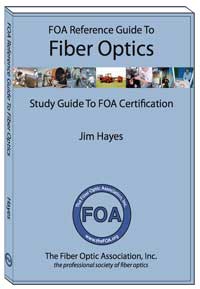
- The exam is based on
the FOA textbook, the FOA
Reference Guide To Fiber Optics, or the FOA
Online Reference Guide online,
particularly the section Understanding
Fiber Optics, the Basics, and the FOA
Installation Tech Bulletin which should be used as
references for any classes that aim toward FOA CFOT
certification.
To
simplify preparation, you should take the Fiber
U Basic Fiber Optics course that is preparation for
the CFOT exam and get your Certificate of Completion.
- You can also read
the FOA Reference
Guide To Fiber Optics textbook and answer all the
chapter questions.
- Installation
techniques, standards and codes are important and the CFOT
exam will cover these topics. Take the FIber
U Basic Skills Lab to prepare.
-
|