- CPCT
- Certified Premises Cabling Technician - is the FOA
certification for designers, installers and operators of
premises cabling networks. Premises cabling refers to
building and campus cabling that is generally customer-owned
and used for local area networks of computers (LANs),
security systems (CCTV and alarms), building management
systems, distributed antenna systems (DAS for cellular and
WiFI) and other applications inside buildings or on a
campus. The FOA CPCT certification
KSAs cover copper and fiber optic cabling and wireless
communications.
- Prerequisites:
None, online self-study course
Fiber U Premises Cabling,
recommended for all students to
prepare for the classroom courses or direct exam
What To Expect In Training Programs For CPCT Certification
To qualify for CPCT Certified Premises Cabling Technician
certification, a training program will cover at least the
following topics:
Overview
of premises cabling systems -copper, fiber and wireless
Communications
systems utilizing premises
cabling
Premises
cabling standards
UTP and
coax copper cabling
Fiber
optic cabling
Cabling
for wireless
Design
of premises
cabling networks
Installation
of
premises cabling
Testing
copper and fiber optic cable plants
Hands-On
Lab Exercises including cable preparation, termination and
testing
Typical Field Experience For Direct CPCT Certification (Work to
Cert)
- To
qualify for the CPCT certification, at least two years of
relevant field experience is required, including
documented experience installing and testing
premises cabling networks. Training by employers,
manufacturers or vendors of cabling products may be recognized
as part of the experience requirements.
Field
experience installing and testing
premises cabling networks must include the following:
- Participation
in multiple installation jobs, preferably including building
and campus installations
- Installing
various cable types and hardware
- Terminating
UTP and coax cable and fiber optics,
- Testing
copper and fiber cables
- Experience
with appropriate tools and test equipment
What To Study To Prepare For The Exam
For
preparation for the CPCT course or direct exam, you should study
the FOA textbook take the
self-study
Fiber U Premises Cabling online course,
- CPCT
- Certified Premises Cabling Technician - is the FOA
certification for designers, installers and operators of
premises cabling networks. Premises cabling refers to building
and campus cabling that is generally customer-owned and used
for local area networks of computers (LANs), security systems
(CCTV and alarms), building management systems, distributed
antenna systems (DAS for cellular and WiFI) and other
applications like industrial systems, electrical distribution
management systems, etc.
FOA CPCT
certification includes all types of infrastructure for premises
cabling and communications - copper and fiber cabling and wireless
systems. CPCT certification is based on KSAs
(knowledge, skills and abilities) that require a knowledge of
cabling and wireless technology and standards along with
demonstrated skills in the installation of copper and fiber
cabling system to support networks. Most CPCTs will work as
contractors and installers, although the certification provides
excellent training for IT or security personnel responsible for
the operation of networks. CPCT courses will generally be 50%
hands-on labs developing the skills necessary for working with
premises cabling systems.
FOA CPCT certification is available as a first level FOA
certification for those with no prior FOA certifications. Those
who already have CFOTs will learn more about copper, wireless and
how fiber is used in structured cabling networks.
- How
Does One Qualify for the FOA CPCT?
FOA CPCT certification
means the person has demonstrated extensive basic knowledge of
copper cabling, fiber optics and wireless as used in premises
cabling systems. They have also demonstrated skills and abilities
in the processes used in the industry for installation. These
requirements are summarized as
KSAs (knowledge, skills, abilities).
Knowledge is tested in the FOA CPCT exam taken by all applicants.
Skills can be demonstrated in hands-on lab exercises and verified
by instructors giving an FOA-Approved course or for those already
working in the industry, verified industry experience.
Abilities: Techs need the ability to perform relevant tasks,
evidenced by showing skills in hands-on tasks.
- There are two paths
to CPCT certification: 1) training at an FOA-Approved
school or 2) experience in the industry and other
training or self-study
using the Fiber U Premises Cabling online course, as
preparation for taking the FOA CPCT exam.
Anyone who attends a CPCT course at an FOA-Approved
school will take the exam as part of the course.
- Find an FOA-Approved
school
- Experienced techs
can apply directly for FOA Certification through FOA's
"Work to Cert" Direct Certification Program
-
- What Are the Benefits of FOA
Certification ?
Like any
certification program, the benefits to the members who pass
the certification tests are based on the recognition of
achieving a level of competence in the fiber optics field. For
the end user looking for competent fiber optic personnel, it
is the knowledge that this person has demonstrated knowledge
and ability in the field and, perhaps even has documented
experience. For the vendor of fiber optic products, it offers
a technically- qualified pool of employees as well as
contractors to recommend to end user customers who need to
find installers for their networks. Many companies require FOA
certifications or even offer FOA certifications to their
personnel through internal training classes.
-
- What
Training Is Required To Take The Exam?
- Most CPCTs obtain
their certification by attending an FOA Approved school.
The exam is based on the FOA-written textbooks, The
FOA Reference Guide to Premises Cabling or the
FOA Online
Reference Guide website for those who wish to study for
it themselves.Studying for the exam can also be done online using
the Fiber U Premises Cabling online course.
For those wanting a formal
course of study, there are many FOA-approved
schools that include the FOA CPCT in their programs. To see
what is involved in the courses, see Detailed
Curriculum Requirements For FOA-Approved Training Programs.
FOA Schools Use These CPCT
Curriculum Topics:
- Introduction to
Premises Cabling
- Structured Cabling
Description and Standards
- Premises Wiring
- Premises Fiber
Optics
- Wireless
- Hands-on Labs:
Wiring (cable, punchdowns, jacks and plugs) and fiber optics
(premises cabling, termination and testing)
-
Preparing
For The CPCT Exam
- If you are planning
on taking the CPCT exam, you need to study the materials on
which the exam is based. The exam is a written exam consisting
of 100 multiple choice, matching and true false questions. The
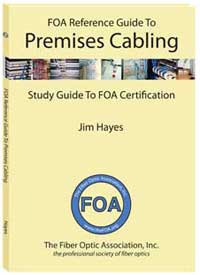
exam is based on the FOA-written textbook, The
FOA Reference Guide to Premises Cabling or the
FOA Online
Reference Guide website. For
a guide to self-study for the FOA CPCT exam, go to Fiber
U, the FOA free online self-study website.
- You should take the
self-study
Fiber U Premises Cabling online course
and obtain a certificate of completion or read the
FOA textbook or Online Reference Guide and answer all the
chapter or section questions.
-
- Experienced techs
may apply directly for FOA Certification through FOA's
"Work to Cert" Direct Certification Program
-
Changes
- The
FOA reserves the right to make changes to the certification programs without notice.
|