
Fiber optics is full of jargon but it's
important to understand it. One of the more confusing terms to many is
"wavelength." It sounds very scientific, but it is simply the term used
to define what we think of as the color of light.
Light is part of the "electromagnetic spectrum" that also includes
x-rays, ultraviolet radiation, microwaves, radio, TV, cell phones, and
all the other wireless signals. They are simply electromagnetic
radiation of different wavelengths. We refer to the range of wavelengths
of electromagnetic radiation as a spectrum.
Wavelength and frequency are related, so some radiation is identified by
its wavelength while others are referred to by their frequency. For the
radiation of shorter wavelengths, light, UV and x-rays, for example, we
generally refer to their wavelength to identify them, while the longer
wavelengths like radio, TV and microwaves, we refer to by their
frequency. 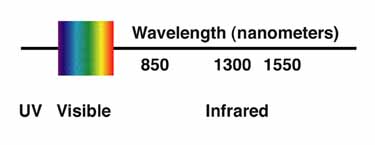
The light we are most familiar with is, of course, the light we can see.
Our eyes are sensitive to light whose wavelength is in the range of
about 400 nanometers (billionths of a meter) to 700 nanometers, from the
blue/violet to the red. If you wonder why this is the range of colors we
can see, it's because it is the same region as the brightest output of
the sun. In other words, we developed sight in the spectral range of the
output of our local star, quite a good idea actually.
For fiber optics with glass fibers, we use light in the infrared region
which has wavelengths longer than visible light, typically around 850,
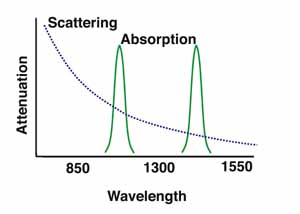
1300 and 1550 nm. Why do we use the infrared? Because the attenuation of
the fiber is much less at those wavelengths. The attenuation of glass
optical fiber is caused by two factors, absorption and scattering.
Absorption occurs in several specific wavelengths called water bands due
to the absorption by minute amounts of water vapor in the glass.
 Scattering
is caused by light bouncing off atoms or molecules in the glass. It i s
strongly a function of wavelength, with longer wavelengths having much
lower scattering. Have you ever wondered why the sky is blue? It's
because the light from the sun is more strongly scattered in the blue.
Scattering
is caused by light bouncing off atoms or molecules in the glass. It i s
strongly a function of wavelength, with longer wavelengths having much
lower scattering. Have you ever wondered why the sky is blue? It's
because the light from the sun is more strongly scattered in the blue.
Fiber optic transmission wavelengths are determined by two factors:
longer wavelengths in the infrared for lower loss in the glass fiber and
at wavelengths which are between the absorption bands. Thus the normal
wavelengths are 850, 1300 and 1550 nm. Fortunately, we are also able to
make transmitters (lasers or LEDs) and receivers (photodetectors) at
these particular wavelengths.
If the attenuation of the fiber is less at longer wavelengths, why don't
we use even longer wavelengths? The infrared wavelengths transition
between light and heat, like you can see the dull red glow of an
electric heating element and feel the heat. At longer wavelengths,
ambient temperature becomes background noise, disturbing signals. And
there are significant water bands in the infrared.
Plastic optical fiber (POF) is made from materials that have lower absorption at shorter wavelengths, so red light at 650 nm is commonly used with POF, but at 850 nm attenuation is still acceptable so short wavelength glass fiber transmitters may be used.
We often refer to wavelengths in fiber optics. The wavelengths we use
for transmission must be the wavelengths we test for losses in our cable
plants. Our power meters are calibrated at those wavelengths so we can
test the networking equipment we install.
The three prime wavelengths for fiber optics, 850, 1300 and 1550 nm
drive everything we design or test. NIST (the US National Institute of
Standards and Technology) provides power meter calibration at these
three wavelengths for fiber optics. Multimode fiber is designed to
operate at 850 and 1300 nm, while singlemode fiber is optimized for 1310
and 1550 nm. The difference between 1300 nm and 1310 nm is simply a
matter of convention, harking back to the days when AT&T dictated
most fiber optic jargon. Lasers at 1310 nm and LEDs at 1300 nm were used
in singlemode and multimode fiber respectively.
| Plastic Optical Fiber (POF) | Multimode Graded Index Fiber | Singlemode Fiber |
| 650 nm | ||
| 850 nm | 850 nm | |
| 1300 nm | 1310 nm | |
| 1490 - 1625 nm |
Recent telecom systems use wavelength-division multiplexing (WDM),
either DWDM
(dense WDM) or CWDM (coarse WDM).
In these systems, lasers are chosen with precise wavelengths closely
spaced - but not so close they interfere with each other - and
transmitted simultaneously on a single fiber. It's just like the FM
radio spectrum. WDM can use the full range of wavelengths between 1260
and 1670 nm in various bands. More on
the wavelength bands used in SM fiber.
A Note on Safety
The final note is on safety. Look closely at the first drawing above.
The visible spectrum is well below the wavelengths used in fiber optics.
That means you generally cannot see the light in fiber systems, so there
is no reason to look into the end of a fiber to see if there is a
signal. Some fiber optic systems like CATV and DWDM do have enough power
to be potentially dangerous, so you should never look at the end of a
fiber unless you have tested it with a fiber optic power meter and know
that there is no optical power present..
(c) 2002-19,
Return To The FOA Home Page