Alternatives To Fiber Optic Termination In The Field:
Prepolished/Splice Connectors With Mechanical Splices
And Fusion Splices (SOCs)
The termination
of fiber optic cable has always been considered the most
difficult part of installing fiber optics. First you have
to deal with hair thin strands of glass. Then you have to
glue a connector on the end of the fiber and crimp it to
the cable. Then, you polish the ends to get good
performance.
Numerous
methods for adhesive/polish connectors have been developed
in attempts to simplify fiber optic termination and speed
up the process. Epoxies that cured overnight were replaced
by epoxies that cure in 5 minutes at higher temperatures
in an oven. Quick-curing adhesives, called "anaerobics,"
can reduce adhesive curing time to less than 5 minutes. 3M
has the "Hot Melt" connector that you heat up to melt the
adhesive, insert the fiber and let it cool to set.
Companies have
spent many millions developing non-adhesive connectors.
Some crimp on the fiber but still require polishing.
Others crimp and cleave the fiber (cleaving is the process
of breaking the fiber under controlled conditions to
produce a end finish in one step.) Finally, many
companies have developed an option worth considering:
prepolished connectors where you splice the fiber into the
connector for termination.
Prepolished splice connectors
eliminate the need for adhesives and polishing for field
termination. They come in two varieties - a factory
terminated connector with a stub fiber in the ferrule that
uses a mechanical splice to terminate the fiber or a
factory terminated connector with a short pigtail that is
fusion spliced on the fiber being terminated.
Termination only requires preparing the cable, cleaving
the fiber, splicing the connector onto the fiber and
adding a strain relief boot.
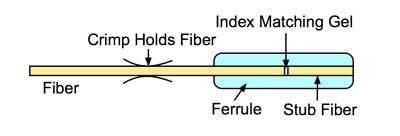
Prepolished/splice connector with mechanical splice
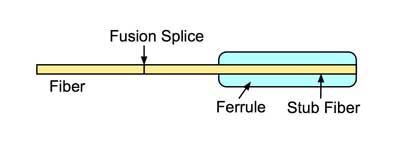
Prepolished/splice
connector with fusion splice
Most people refer to the
connectors with mechanical splices as "prepolished/splice
connectors" and the ones that use fusion splicing as
"splice-on connectors" (SOCs).
Fiber optic connector manufacturers
make prepolished/splice connectors by gluing a short stub
fiber into the connector ferrule and polishing it
perfectly with machines in the factory.
The back of the mechanical splice
connector is modified with the addition of a mechanical
splice, complete with index-matching gel to reduce loss at
the fiber interface and a crimp to hold the fiber.
Terminating these connectors is super-simple: cleave the
fiber, insert it into the connector, crimp it in place and
you are finished. No adhesive, no polish. Terminate a
fiber in less than one minute.
SOCs have a short pigtail on the back
of the connector ready to be cleaved with the fusion
splicer cleaver and fusion spliced on to a fiber. The time
for this termination is no longer than the time to make a
fusion splice.
A misconception concerns connectors that are installed by
splicing on the end of a fiber, wither by mechanical or
fusion splicing, or by splicing on a pigtail. The
connection loss of this type of termination includes the
typical connection loss tested when mated to a reference
connector plus the splice used to attach the connector to
the fiber, as the splice is the attachment method and
therefore included in the connection loss. This is how
standards often list high losses for connectors because
they must include not only the direct attach
adhesive/polish connectors but also splice-on connectors
and array connectors with many fibers.
SOCs
- Fusion Splice-On Connectors
Splice-on connectors are a
relatively new development that has been seeing greater
acceptance with installers. of the SOC. It's popularity
started in data centers for singlemode fiber where the
number of connections is very large so the cost of a
fusion splicer is readily amortized and the speed of
making connections is the real cost advantage. The
cost of fusion splicers has been dropping to near the
cost of a prepolished/splice (mechanical splice)
connector kit so the financial decision to use SOCs is
easier to make. The
performance of SOCs is much better than
prepolished/splice (mechanical splice) connectors simply
because of the superiority of a fusion splice over a
mechanical splice and the cost of the SOCs are much less
since they do not have the complex mechanical splice in
the connector.

SOC installation process with the EasySplicer.
Termination with a SOC is simple. The
fiber to be terminated is prepared as usual: strip,
clean, cleave and insert in the splicer. The connector
is placed in a special holder that positions it in the
cleaver to cleave the fiber at the proper length. The
holder is inserted in the splicer, the program is run to
make the splice and a heat shrink protector completes
the process.
Detailed
process description for the EasySplicer SOC
installation.
Connectors With Mechanical Splices
Prepolished splice connectors are very
fast terminations but are not without their downsides.
Since there is a mechanical splice and a connector, the
total loss includes one connector plus a splice loss.
Since the splice loss is dependent on the quality of the
fiber cleave, it requires a very precise cleave from a top
quality cleaver. Since the fiber is not attached with
adhesive, the attachment strength depends on a good crimp.
The latest generation kits solve most of those problems so
prepolished/splice connectors can now provide a very fast
termination with satisfactory loss if a few precautions
are followed.

Corning Unicam Pretium termination process includes
verification of proper splice
The economics of prepolished splice
connectors is based on the lower time needed for
each termination. The manufacturing process makes each
connector more expensive and the good kits with quality
cleavers are more expensive than adhesive/polish
termination kits, even those with epoxy curing ovens.
However, the lower cost of labor can make these connectors
cost effective, especially when only a few connectors are
being used. The secret to lowering costs is getting high
yield of good connectors and that depends on having the
right tools and training - and practice.
These connectors will never have loss
as low as an adhesive connector, since they are actually
an adhesive/polish connector with a mechanical splice
inside them so you have both a connector loss and a spice
loss. The good news is the connector factory polish is
first class, so the connector to connector interface has
low loss, probably averaging better than 0.2 dB loss. The
bad news is the splice can add 0.3-0.5 dB to the total
loss of the termination, making them a 0.5-0.7 dB
connector at best.
Techs now achieve around 0.5 dB loss
from these connectors, using an quality cleaver typically
used with fusion splicers. This cleaver produces
consistent, high quality cleaves to mate with the fiber
stub in the connector. The fiber must be inserted
into the connector and kept under tension during the crimp
process, to make sure the two fiber ends in the internal
splice stay in contact. Using these techniques, techs have
been getting excellent yield of connectors that better the
TIA-568 standard requirement of 0.75 dB loss or less. Some
manufacturers of prepolished/splice connectors acknowledge
these issues, and they now offer termination kits with
precision cleavers and tools that carefully hold the fiber
and connector during the termination process.
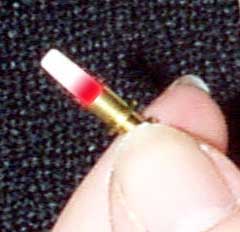
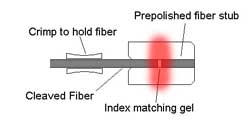 Another
trick in using these connectors is to visually confirm the
quality of the splice you make in terminating them, an
automatic feature of newer termination kits. A visual
fault locator (VFL) with a bright red laser can be used to
optimize the internal splice. The light lost in the splice
is visible through the body of the connector, so one can
confirm the splice is good when the red light is
minimized. Adding a VFL to your toolkit along with a
precision cleaver is another necessity.
Another
trick in using these connectors is to visually confirm the
quality of the splice you make in terminating them, an
automatic feature of newer termination kits. A visual
fault locator (VFL) with a bright red laser can be used to
optimize the internal splice. The light lost in the splice
is visible through the body of the connector, so one can
confirm the splice is good when the red light is
minimized. Adding a VFL to your toolkit along with a
precision cleaver is another necessity.
It’s mandatory to get good training on
the termination process for these connectors, even if you
are already familiar with adhesive/polish connectors. Most
manufacturers’ termination kits include special tools for
holding and crimping the connector, as well as that
inexpensive cleaver that we recommend you replace by a
really good one. It is absolutely mandatory to get trained
on the use of these tools and the exact process
recommended for termination. And, of course, you should
practice enough with these connectors to become proficient
in their use before bidding or using them on a job.
The economics of these connectors
depends heavily on the yield of good connectors during
installation. When a prepolished connector costs
considerably more than an adhesive connector, it is
critical to make sure every connector installed is a good
one. That’s why a quality cleaver, a VFL and a couple of
days training is a worthwhile investment. Only when an
installer can equal the yield of adhesive/polish
connectors can a direct comparison of installed costs be
made. Then the advantages of these connectors fast
termination times can be fully exploited to save labor
costs in any project.
Unicam termination photo courtesy Corning Cabling Systems.
Virtual
Hands-On Instructions For Prepolished/Splice
Connectors.
See the FOA video on prepolished connectors on 
Table of Contents: The FOA
Reference Guide To Fiber Optics
|