Alternatives To Fiber Optic Termination In The Field:
Prefabricated Cabling Systems
Termination of installed optical fiber cables has always been perceived as a difficult, expensive, time consuming process that discouraged some contractors from developing in-house capability for fiber installation. The myth that fiber is fragile because it’s made of glass and difficult to install has persisted, even though fiber is the most widely used communications medium and many contractors have added it to their capabilities.
Recently, new high speed systems have intensified some contractors fear of fiber. Multimode fiber networks for 40 and 100 gigabits/second use parallel transmission with 8 or 20 fibers per link using 12-fiber MTP/MPO connectors that are not easily terminated in the field. The new generation of optical LANs based on fiber to the home technology (FTTH) uses singlemode fiber, not multimode, that has added to the concern over installation. The smaller singlemode fiber added to the concern because most contractors are unfamiliar with the installation of singlemode cabling.
Is it necessary to field terminate fiber optic cabling systems? Not necessarily. If one has a good cable plant layout design and can accurately determine cable lengths between termination points, it's possible to have a complete cabling system factory made and delivered to the worksite ready to install and plug together.
Prefabricated cable assemblies have been around for decades. In the early days of fiber optics for premises links, making a good field termination was more difficult than today. Many connectors used metal ferrules to hold the fiber that were hard to glue to the glass fiber. These metal connectors were difficult to properly polish because the metal contaminated the polishing films, sometimes requiring wet polishing. And the tolerances on the machined ferrules make low loss connectors a hit-or-miss proposition.
Many cable and patchcord manufacturers offer a cable termination service. You specify what kind and number of fibers you needed, the cable and connector type and the length and the manufacturer would supply a completed assembly. And they guaranteed the connector and cable losses. There was no field termination needed.
However, it was very important to accurately specify the cable length. That could be difficult in a premises environment, where cables go up and down walls, over ceilings and around obstacles. The usual method was to have plenty of extra length and store the excess in service loops in out of the way places like above the ceiling.
Another problem was how to protect the connectors because of the handling required during the installation process. Several manufacturers designed custom boots that fit over the connectors for protection and included a pulling loop attached to the strength members of the cable. (Photos shown courtesy of Nexans)
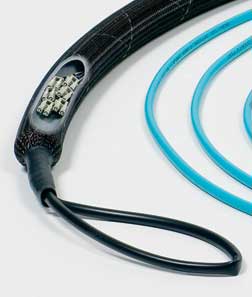
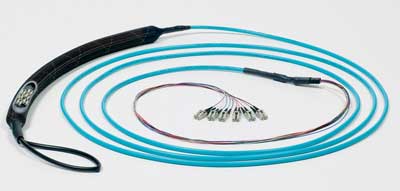
This worked fairly well, especially for small fiber count cables of the breakout type where the jacketed simplex fibers provided protection to each connector. Distribution cables required more care because the connectors directly attached to the tight-buffered fibers had less protection. But under any circumstances, the total fiber count was limited because of the size of the fiber optic connectors common to the era made bunches of them inside a pulling boot bulky and hard to pull.
The next development was creating a modular system that used multifiber cables with mass termination connectors (generally MPOs which are sometimes called MTPs - a trade name) and plug-in modules at the patch panel. Ribbon cable has become a standard item, widely used in many large fiber count cables. Ribbon connectors, especially the MPO, have improved in performance enough to allow them to be used in mass terminations of pre-terminated cables. With the MPO, 12 fibers can be terminated in a connector hardly more bulky than a typical SC, which is easily pulled and installed. Using 12 fiber ribbon cables and MPO connectors, 12 connector modules could be easily prefabricated and installed. Complete modular systems included a module at each end and prefabricated ribbon cables for installation between termination points.
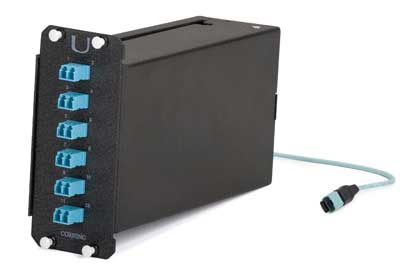
(Photo courtesy Corning Cable Systems)
MPO connectors present a challenge for testing with most fiber optic test equipment designed for single fiber testing. Here is a complete page with descriptions of the MPO connectors and the challenges it presents for testing.
Verizon’s desire to reduce installation time and cost in their fiber to the home programs (FiOS) spurred the development of outside plant prefab fiber optic cabling systems. The Verizon need was a result of volume. When you need to install connections to several million homes per year, small savings in time and labor cost become very important. In addition, finding enough experienced installation techs or training them is not easy.
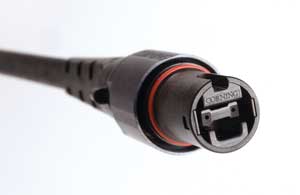
Manufacturers like Corning Cable Systems actually came up with a simple, elegant solution. Create a rugged, weather-sealed plastic shell around the MTP connector that provides protection before, during and after installation. Multifiber cables are installed by regular fiber techs from the central offices to near the homes, where mating drop boxes with 4, 6, 8 or 12 terminations are available. The FTTH tech plugs a cable into the drop box on one end an a network interface box on the home and the fiber installation is completed.
Another technical development has made installing prefab cable assemblies indoors, bend-insensitive fiber. This allows for smaller cables that are more flexible and fit in smaller pathways. In fact bend-insensitive fiber is used in some outdoor cables for the same reason.
But is a cabling system based on a concept developed for applications numbering in the millions cost effective for a single custom system? The only generalization that can be made is a factory-made product will probably be higher in component cost and lower in installation labor cost. For any given installation, it’s really necessary to price it both ways (being realistic on installation costs) for a cost comparison. Then the customer should consider the intangibles.
Prefabricated systems are faster to install so if the cabling is going into a building currently occupied, say an airport, it may cause less work disruption. If the location is in a big city where labor costs are high, the factory-made system may be lower cost. If good design drawings are available, like in new construction, the engineering time to develop the cable plant design may be much lower.
Handling And Cleaning, Testing
Prefab cables are not immune to problems. They must be handled carefully to avoid damage during unpacking and installation. Connectors must be carefully cleaned before connecting to other cables, modules or equipment. Testing often requires special reference cables and procedures for use with the multipin MTP/MPO connectors (more). Manufacturers generally supply information on handling these cables and their directions should be followed.
Things To Consider If Considering Prefab Cabling
Prefab cabling systems allow faster installation and comparable costs to field termination, but are not without their problems. Designing the cabling system is the first problem. It must be accurately designed so cables can be built close to the exact length. Too short and the cabling won’t work, too long and it requires finding locations for storing excess cable in service loops. One manufacturer described the problems encountered in one installation where ~50 meters of excess cabling was stored in figure-8 coils under a raised floor.
Most manufacturers offer assistance in designing the prefab cable plant, which, of course, is easier in new construction where CAD drawings are available. But the contractor must know the building where the cables will be installed well enough to plan for the cable to be the proper length to end up where it is supposed to while avoiding all the obstacles in between. Older buildings can be a big problem getting exact lengths for the cables and finding storage for excess cables. It is also the contractor’s responsibility to find out if the prefab cable will require special sizes of conduit, cable trays or unusual firestopping.
Installation of a prefab cabling systems may be more difficult than bare cable since the ends with connectors, even inside protective covers, tend to be bulky and require more care to prevent damage to the connectors on the ends. Running cables inside walls or pulling in conduit may be more difficult. Manufacturers can design cables that fit in the common fiber optic innerducts as long as the contractor specifies this in the order.
Installers still need some training to install prefab cabling systems. They need instruction on how cables have to be handled with care to prevent damage due to pulling tension, kinking or pulling around sharp corners. Cables must be laid such that they are not subjected to excess cable weight pressing on them in cable trays.
Care must also be taken to not harm the connectors on the ends. The installers must know how to handle the ends during pulling and how to remove the pulling grips without damaging the ends. And every installer making connections with the cables, either to cable breakout modules in a patch panel or other cables must know how to clean the connectors and handle the connections properly.
Most cable companies that offer prefab cabling systems will offer a warranty on the cable plant if it is installed by one of their certified installers. Contractors may be forced to have their crews trained by the manufacturer in order to offer the customer the cabling warranty or the manufacturer may recognize generic certifications like the FOA CFOT.
Finally, there is the issue of testing. The installer still has to test the installed cables for documentation to present to the customer. That brings up the issue of correlation of the field test data with the factory test reports. Test results can be a big issue because of the differences in test equipment used by the manufacturer and the contractor and the inherent uncertainties of fiber optic measurements, especially with multimode BI fiber. Methods for testing multimode BI fiber are still being developed, so it is important to follow the manufacturer’s directions for testing. Plus, there may be lots of “finger pointing” if a cable or connection tests as unacceptable. Was it shipped from the factory that way, damaged in transit or damaged during installation? Should the contractor have tested it in the box before installing it?
How Do You Make A Choice?
All these issues have led many contractors to simply get personnel trained to design and install fiber optics and equip their crews properly. Advances in termination methods, including much better fast termination techniques like the prepolished/splice style connectors, have simplified the installation process considerably and fiber optic installation work can be highly profitable.
In the past, most contractors looked to prefab cabling for singlemode installations because direct termination was more difficult than multimode. Singlemode termination requires tighter tolerances and different polishing processes. The traditional alternative, fusion splicing on pigtails, required a very expensive fusion splicer and a trained operator. But the millions of fiber to the home installations and rapidly growing number of premises singlemode networks have led to major performance advances in prepolished/splice connectors, making them cheaper, faster and more reliable. Now an installer with a termination kit and a few hours of training can do perfectly acceptable singlemode terminations in a couple of minutes.
But multimode installations, usually considered easy by most installers, has a new variation that changes the situation. LANs using multimode fiber at speeds of 40 and 100 gigabits/second (10Gb/s ) are now using parallel transmission, with multiple links of 10Gb/s per fiber in each direction. Thus a 40 10Gb/s link will use 8 fibers and a 100 10Gb/s link needs 20 fibers. These parallel links use 12-fiber MTP/MPO connectors that are not generally considered field installable. When a customer wants a network for these systems, a prefab cabling system may be the only logical choice.
Other applications are also commonly installed with prefab systems where installation is difficult or time is a big issue. For example, cellular systems are expanding from fiber backhaul to the cell tower then up the tower to the antennas. Fiber to the antenna almost always uses prefab cables or at least pigtails that are plugged into the antennas on the tower end and terminated inside enclosures on the ground.
With the prevalence of fiber optics in today’s networks, contractors doing low voltage work need to become competent in fiber optics. This involves not only getting employees trained in installation but also having staff who understand fiber optic network design and who keep up with the state of the art in technology and products. That involves keeping up with new technology, products and applications that affect your contracting decisions.
Here are other FOA Guide pages that might be helpful:
Table of Contents: The FOA Reference Guide To Fiber Optics
|