Connector Types and Terminology – What's In A Name?
Rarely do FOA instructors present a fiber optic
seminar without getting some questions on what some
connector terminology means or how such a term or
connector name originated. Since some of us have been
in the business for over 25 years ourselves, we do
remember some of the origins of these terms and find
it amusing to share the stories. But we’ll also cover
some important information about fiber optic connector
design and termination along the way.
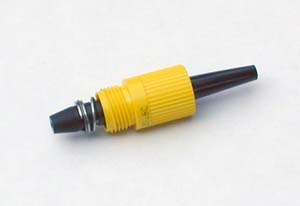 The AT&T Biconic
Some of you may remember the Biconic and SMA
connectors which were the most popular connectors 25+
years ago. (Here
is the FOA Tech Topic that identifies most popular
connectors from the history of fiber optics.)
AT&T named their first commercial fiber optic
connector the “Biconic” since the connector had a
conical molded-plastic ferrule that fitted into a
“bi-conical” mating adapter when connected to another
connector. The original Biconic was actually molded
around the fibers to get exact centering, a practice
that stopped when they developed a way to insert a 125
micron ( 5 mil) pin in the plastic molding cavity to
produce a connector ferrule with a hole into which
fibers could be epoxied.
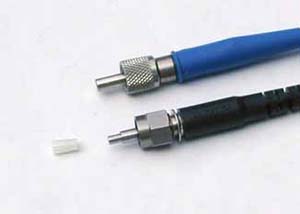 SMA
SMA
The SMA connector was the first connector widely used
for data links using multimode fiber. It was developed
by Amphenol using the hardware from the “SubMiniature
A” microwave connector, hence it’s name, with a
precise 1/8 inch machined metal ferrule.
The next major development in fiber optic connectors
came from Japan, with the development of the ceramic
ferrule. Metal ferrules had a problem with glass
fiber. The uneven expansion coefficients sometimes
caused the adhesive to fail, allowing the fiber to
extend or retract, a process called “pistoning.” The
ceramic ferrule had a very low expansion, like glass,
so the adhesive held better, the connector could be
polished to a finer finish and performed better over
extremes in temperature.
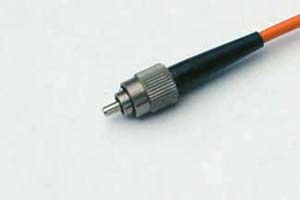 NTT FC
 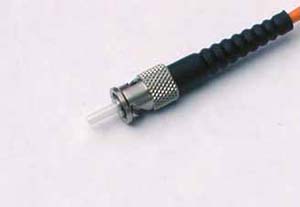 AT&T ST
 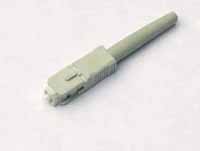 NTT SC
The “FC” or “fiber connector” from NTT (Nippon
Telephone and Telegraph) was the first connector to
use the 2.5 mm ceramic ferrule. Shortly thereafter,
AT&T introduced the “ST” or “straight terminus”
(contrasting to the “biconical” – get it?) that used
exactly the same ceramic ferrule as the FC but
replaced the screw-on nut of the FC with a bayonet
lock like a BNC coax connector, simplifying and
speeding up connector insertion. NTT responded a
couple of years later with the “SC” or “subscriber
connector” and the ST and SC dominated fiber optics
for over a decade.
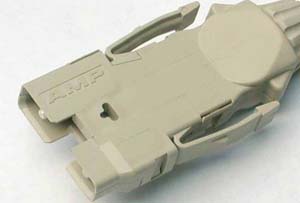
The 2.5 mm ferrule was also used in the FDDI and ESCON
connectors, both named for the systems for which they
were designed. The connectors with two ferrules, one
for fibers transmitting and receiveing in opposite
directions, are called "duplex" connectors.
 FDDI
FDDI 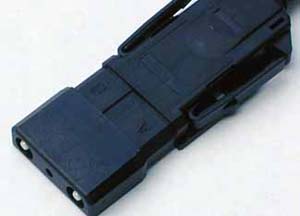 IBM ESCON
The next confusing nomenclature for fiber optic
connectors came from the polishing of the end of the
ferrule, giving us “PC,” “Ultra PC” or “Super PC” and
“APC” connectors. As the long-haul industry moved from
multimode (MM) to singlemode (SM) fiber around 20
years ago, the reflections at SM connections caused
big problems with most laser sources. The reflections
actually interacted with the lasers, causing
instability and noise in the laser itself.
Early connectors like the biconic and SMA, which
did not have keyed ferrules and could rotate in mating
adapters, always had an air gap between the connectors
to prevent them rotating and grinding scratches
into the ends of the fibers. The air gap between
the fibers causes a reflection when the light
encounters the change in refractive index from the
glass fiber to air in the gap.
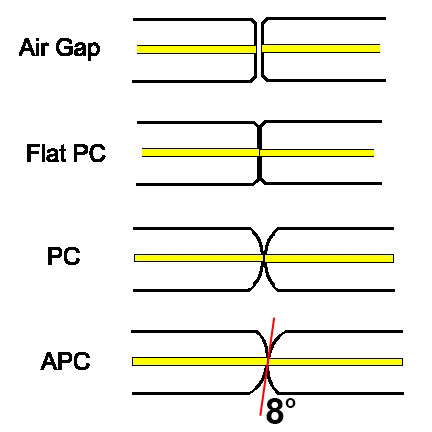
Beginning with the ST and FC, which had
keyed ferrules, connectors were designed to contact
mating ferrules tightly, creating what we now
call “PC” or “physical contact” connectors.
Reducing the air gap reduced both loss and back
reflection, since light has a loss of
about 5% (~0.25 dB) at each air gap. While air gap
connectors usually had losses of 0.5 dB or
more and return loss of 20 dB (1%), PC connectors had
typical losses of 0.3 dB and a return loss
of 30 to 50 dB (0.1 to 0.001%.)
Connectors use a number of polishing techniques
to create a convex end to the connector ferrule to
insure physical contact of the fiber ends. Hand
polishing is done on a rubber pad and machine
polishing uses concave polishing fixtures. “Super PC”
or “Ultra PC” are simply marketing names various
manufacturers give to their polishing processes.
The final solution for singlemode systems extremely
sensitive to reflections, like CATV or high bitrate
telco links, was to angle the end of the ferrule 8
degrees to create what we call an “APC” or
“angled PC” connector. Then any reflected light
is at an angle that is absorbed in the cladding of the
fiber.
It seems like more recent connectors, like the “SFF”
or “small form factor” connectors were named by the
marketing department instead of engineering, which is
why we have names like “Volition” and “OptiJack.”
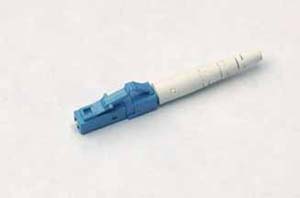 AT&T LC
But the
exception is the "LC" or lightwave connector.
A new class of connector introduced in the late 1990s
was the “MT” (“mass termination” or
"multiple termination") connector. The first was a duplex
connector, the “MT-RJ” where “RJ” refers to the
“RJ-45” style of copper connector whose form factor it
emulates. These multi-fiber connectors also come with
one or more rows of 12 or 16 fibers, called "array
connectors" or MPO
- "multi-position optical," "multi-fiber push-on" or a
trade name
"MTP."
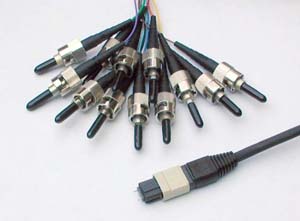 MPO
MPO 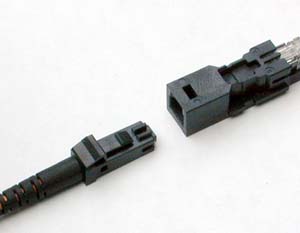 MT-RJ
MT-RJ
Fiber
Optic Connector Identifier - What Connector is
THAT?
|