General Guidelines For Installing Fiber Optic
Cable
Fiber optic cable may be installed indoors or outdoors
using several different installation processes.
Outdoor cable may be direct buried, pulled or blown
into conduit or innerduct, or installed aerially
between poles. Indoor cables can be installed in
raceways, cable trays above ceilings or under floors,
placed in hangers, pulled into conduit or innerduct or
blown though special ducts with compressed gas. The
installation process will depend on the nature of the
installation and the type of cable being used.
Installation methods for both wire and optical fiber
communications cables are similar. Fiber cable is
designed to be pulled with much greater force than
copper wire if pulled correctly, but excess stress on
the cable may harm the fibers, potentially causing
eventual failure. Particular care should be taken
during installation to prevent kinking the cable which
can harm the fibers.
Since there are so many types of fiber optic cable and
so many different applications, it is hard to cover
each application in detail. However there are some
general rules that should be followed:
Installation Guidelines
Follow the cable manufacturer's recommendations. Fiber
optic cable is often custom-designed for the
installation and the manufacturer may have specific
instructions on its installation.
Check the cable length to make sure the cable being
pulled is long enough for the run to prevent having to
splice fiber and provide special protection for the
splices.
Try to complete the installation in one pull.
Prior to any installation, assess the route carefully
to determine the methods of installation and obstacles
likely to be encountered.
All fiber optic cables have specifications that
must not be exceeded during installation to
prevent irreparable damage to the cable. This
includes pulling tension, minimum bend radius and
crush loads. Installers must understand these
specifications and know how to pull cables without
damaging them.
Pulling tension
Cable manufacturers install special strength
members, usually aramid yarn (DuPont Kevlar), for
pulling. Fiber optic cable should only be pulled by
these strength members unless the cable design allows
pulling by the jacket. Any other method may put stress
on the fibers and harm them.
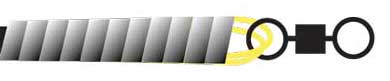
Swivel pulling eyes should be used to attach the
pulling rope or tape to the cable to prevent cable
twisting during the pull.
Cables should not be pulled by the jacket unless it is
specifically approved by the cable manufacturers and
an approved cable grip is used. These grips are
usually tied to the strength members also.
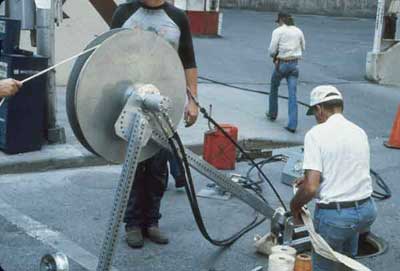
Tight buffer cable can be pulled by the jacket in
premises applications if a large (~40 cm, 8 in.) spool
is used as a pulling mandrel. Wrap the cable
around the spool 5 times and hold gently when pulling.
Do not exceed the maximum pulling tension rating.
Consult the cable manufacturer and suppliers of
conduit, innerduct, and cable lubricants for
guidelines on tension ratings and lubricant use.
When pulling long lengths of cable in conduit or
innerduct (up to approximately 3 miles or 5 kilometers
in the outside plant, hundreds of meters in premises
cabling), use proper lubricants and make sure they are
compatible with the cable jacket.
If possible, use an automated puller with tension
control and/or a breakaway pulling eye. On very
long OSP runs (farther than approximately 2.5 miles or
4 kilometers), pull from the middle out to both ends
or use an automated fiber puller at intermediate
point(s) for a continuous pull.
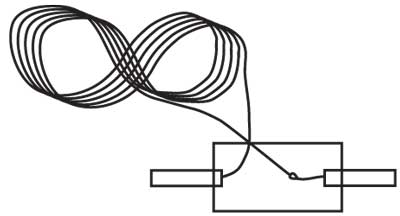
When laying loops of fiber on a surface during a pull,
use “figure-8”
loops to prevent twisting the cable.
Bend radius
Bending
of a fiber optic cable can damage the cable if the
radius of the bend is too small. The normal
recommendation for fiber optic cable bend radius is
the minimum bend radius under tension during pulling
is 20 times the diameter of the cable. When not
under tension (after installation), the minimum
recommended long term bend radius is 10 times the
cable diameter.
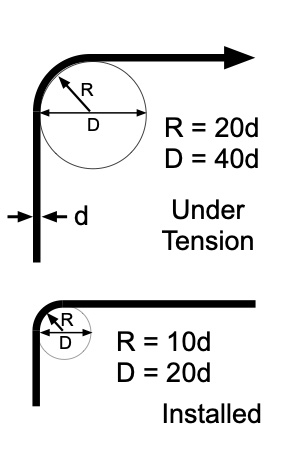
Under
tension (top) and after installation (bottom)
Note:
Always check the cable specifications for cables
you are installing as some cables such as the high
fiber count cables have different bend radius
specifications from regular cables!
Bend radius example: A cable 13mm (0.5") diameter
would have a minimum bend radius under tension of 20
X 13mm = 260mm (20 x 0.5" = 10") That means if you
are pulling this cable over a pulley, that pulley
should have a minimum radius of 260mm/10" or a
diameter of 520mm/20" - don't get radius and
diameter mixed up!
Why
is bend radius important? Not following bend radius
guidelines can lead to cable damage. If the cable is
damaged in installation, the manufacturer's warranty
is voided. Here is what one manufacturer's warranty
says: "This
warranty does not apply to normal wear and tear or
damage caused by negligence, lack
of maintenance, accident, abnormal operation, improper
installation or service, unauthorized
repair, fire, floods, and acts of God." And
their specifications call our the minimum bend
radius as "20 X OD-Installation, 10 X
OD-In-Service." Do not exceed the cable bend
radius. Fiber optic cable can be broken when kinked
or bent too tightly, especially during pulling.
Twisting cable
Do not twist the cable. Twisting the cable can stress
the fibers. Tension on the cable and pulling
ropes can cause twisting. Use a swivel
pulling
eye to connect the pull rope to the cable to
prevent pulling tension causing twisting forces on the
cable.
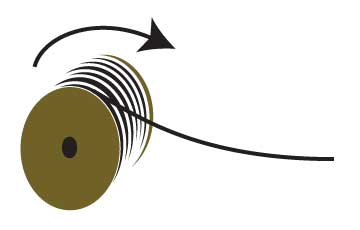
Roll the cable off the spool instead of spinning it
off the spool end to prevent putting a twist in
the cable for every turn on the spool.
When laying cable out for a long pull, use a "figure-8"
on the ground to prevent twisting. The figure 8 puts a
half twist in on one side of the 8 and takes it out on
the other, preventing twists.
Vertical cable runs (Premises)
Drop vertical cables down rather than pulling them up
whenever possible.
Support cables at frequent intervals to prevent excess
stress on the jacket. Support can be provided by cable
ties (tightened snugly, not tightly enough to deform
the cable jacket) or Kellems grips.
Use service loops can to assist in gripping the cable
for support and provide cable for future repairs or
rerouting.
Use Of Cable Ties
Fiber optic cables, like all communications cables,
are sensitive to compressive or crushing loads. Cable
ties used with many cables, especially when tightened
with an installation tool, are harmful to fiber optic
cables, causing attenuation and potential fiber
breakage.
When used, cable ties should be hand tightened to be
snug but loose enough to be moved along the cable by
hand. Then the excess length of the tie should be cut
off to prevent future tightening.
Hook-and-loop fastener ties are preferred for fiber
optic cables, as they cannot apply crush loads
sufficient to harm the cable.
More
on Outside Plant Construction and Installation
|