Topic: Fiber Optic And Cabling Standards |
Table of Contents: The FOA Guide To Fiber Optics |
| What
Is A Standard? See also FOA Standards Here is one definition by the world's biggest standards organization: ISO/IEC Guide 2:1996, definition 3.2 defines a standard as: 'A document established by consensus and approved by a recognized body that provides for common and repeated use, rules, guidelines or characteristics for activities or their results, aimed at the achievement of the optimum degree of order in a given context'. Standards have existed as long as commerce has. Without standards it would be impossible to say how big something is (length standards in feet or meters) or much it weighs (weight in pounds or mass in kilograms). Time needs a standard second to define the length of an event. And so on. Throughout history we have created standards that allow buyer and seller to have a language for commerce. That continues today in our high tech world. No application in the communications industry could work without industry standards. Any standard's main goal is to create uniform specifications for products that ensure interoperability among various manufacturer’s products. Standards start at the component level that cover specifications for connectors and cables, for example, making them intermateable and procedures on how to test them. Standards at the system level cover signal bitrates, frequencies and amplitudes, protocols, data encoding, packet length, timing, error correction and many other factors that are needed to guarantee that systems can talk to each other. Systems like cellphones, Ethernet and WiFi rely on industry standards, as does the cabling that connects them. 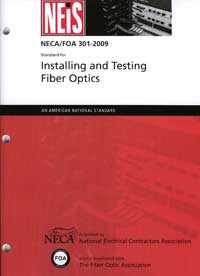 NECA/FOA-301 is a standard for installing fiber optic cable plants. Download a free copy. Manufacturers contribute to the standards so they can have, as a participant who headed one of these committees once said, “mutually agreed-upon specifications for product development.” Telecommunications Industry Association (TIA) and ISO/IEC cabling standards for fiber optics and structured cabling, for example, are written by manufacturers for manufacturers, and as such are much more useful to manufacturers of cables, connecting hardware, networking electronics and test equipment than to end users installing cabling in their networks. Few users actually need to refer to the standards themselves. In fact, few users could be expected to wade through the boilerplate of the standards, translating them from “standardese,” the quasi-legal “language” they are written in, sifting among the minutiae and “shoulds” or “shalls” to try to figure out how to design and install a cabling network. Furthermore, these standards written by manufacturers are continually being updated to reflect the newer technologies that they currently sell to users. As a result, legacy applications are pushed aside for new technology, creating a problem for some users of these systems who need to repair or upgrade their cabling. It's been suggested in the standards committees that users can still refer to older standards when appropriate. Recently TIA has dissolved most of the "FO-x" fiber optic committees and merged a few remaining committees into the TR-42 committees which are primarily involved in structured cabling. The focus of several of these committees has changed considerably and some have simply faded away or being merged into other committees. Manufacturers must provide their customers with products that meet the standards and directions for their proper use, meaning customers generally do not need to depend on understanding the meaning of the standards themselves. Other organizations like the FOA, military, telcos, etc. who represent the interests of users of these products tend to write their own standards that reflect the needs of their members. For standardized fiber optics and premises cabling, standards are now under the auspices of the TIA Technical Committee TR-42 for the US and ISO JTC 1 internationally which also handles premises or structured cabling, including unshielded twisted pair copper and fiber optics. The goal of this committee is to produce a predictable minimum performance level for cabling that manufacturers can use for developing communications products. Those products have traditionally been communications products like telephone systems, CATV systems, Ethernet LANs, but now also include security systems, both CCTV and alarms, building control systems, audio or anything that can work over the standardized cabling system. The cabling standards are minimums, so many companies can offer enhanced products that exceed the standards and offer benefits to certain users, as well as providing a competitive advantage. The manufacturers of network electronics have their own standards meetings where they do similar work, for example Ethernet in the IEEE 802.3 committees and various IEC international telecom standards. Liaison between the network and cabling committees generally assures that their standards will work together. In fact, the committees often use input from each other to set their agendas and technical targets. Other applications that use cabling, such as video, must rely on the cabling standards during their product development, as they are basically proprietary applications, not covered by industry standards. However, should manufacturers of video products want such a standard, they could initiate a similar process to create one. Since the manufacturers develop the standards for their own use, they assume the responsibility for educating their personnel and customers, distributors or end users. Fortunately, companies involved in developing the standards or selling products based on them generally do a very good job of translating the relevant standards into understandable language. Practically every company involved in fiber optic cabling seems to have a section in the back of their catalog and on their website devoted to explaining the standards. It is here, not the standards themselves, where the relevant information is to be found. A quick search of “fiber optic cabling standards” on the Web will give you numerous links to companies and technical websites like the FOA Guide that offer summaries of these standards. Covering standards in textbooks and training programs that cover cabling is difficult. Standards change continuously, with the written, approved versions often lagging current product technology by months or even years. Instructors and authors must hedge on the way they refer to standards, covering the scope of the current and expected future versions, but not trying to offer definitive information on them, which would be hopelessly out of date. The best method of understanding standards is to depend on the manufacturers who write the standards and make products according to them. Their continual involvement ensures up to date information. What About “Pre-Standard” Products or Manufacturer Promises of Extended Performance Applications? During the development of a standard or even for an extended time after the standard is ratified, manufacturers often offer products that are advertised to meet the standard or exceed the performance requirements of the standard. Examples are "bend insensitive fiber" or the products offered for each new version of UTP cabling. You can buy “Category X” cabling for a year or more before the standard is ratified. Manufacturers even offer “Category 7” cable in the US while the TIA has never written a standard for it. Fiber manufacturers offer “bend-insensitive” fibers that have not been through the standards process that may or may not be compatible with regular fibers or other manufacturers BI fibers. They also may require special procedures for splicing, termination and testing. Another example is laser-optimized 50/125 fiber. Manufacturers offer higher bandwidth fibers with promises that networks will run longer distances over this fiber than a network standard’s specified length. Using these products can be risky. UTP cabling at very high speeds has proven to be difficult. It often requires matching cable and terminations using some very subtle technology, and different manufacturers may use different methods to meet the specification. Thus it is sometimes problematic to mix manufacturers products (e.g. cable from one manufacturer and hardware from another) until the technology is fully understood. For fiber manufacturers, issues have included compatibility of bend-insensitive fiber designs and claims that their product supports longer links than allowed under standards which can become a issue if a network has operational problems. System electronics vendors have refused to take responsibility for systems that won’t work over longer distances, laying the responsibility directly on the cabling manufacturer and installer who may not have the resources to make it work. If the products are pre-standard, mixed manufacturers or used beyond system standards, it becomes a “buyer beware” situation. Technical Solutions Evolve and Some Standards Are Proven Wrong All standards for high technology products rely on data that backs up the standard. That data comes from the companies involved in the standards committees. As we all know, sometimes the data is the best we have at the time but is proven wrong or at least not as good as better data or methodology developed in the future. Multimode fiber mode control for testing loss and bandwidth has been known to be a problem since the early 1980s. Solutions proposed in standards have included optical control of the light launched into the fiber and filling all modes and then conditioning the mode fill with mode scramblers and filters (mandrel wrap) while testing of mode fill has varied from far field scans to near field scans using video cameras. In 2010, a new metric, encircled flux or EF, was adopted as apart of TIA adopting an international standard to replace the standard for testing the installed cable plant, OFSTP-14. But EF was based on a theoretical model used for calculating the potential length of 10 gigabit lengths, not actual testing. It was adopted with no clear understanding of how to test EF could be tested and an initial round-robin involving labs and test equipment manufacturers proved inconclusive. A second round–robin was scheduled for 2011, making it impossible to implement EF as a standard for at least an additional year. Furthermore, the new OFSTP-14 allowed OTDR testing as well as insertion loss testing with a light source and power meter with insufficient proof that such a move was justified - which has proven to be another mistake. Since the standards control the markets, the stakes to get standards written to a company’s advantage are high. In 2006, an IEEE standards committee working on a high speed mobile wireless access standard suspended operation amid rumors of political infighting and manufacturers stacking the voting rolls. Factions were accused of stalling tactics, not disclosing commercial affiliations and even “stuffing the ballot box.” It turns out that one company not only had its representatives attending the meetings but also covertly had a majority of other attendees including the chair of the committee on its payroll as consultants. This is not the first or last time this has happened. Lest you think all the technical committees are like this, let us assure you there are many competent engineers working for ethical companies who attend the meetings and work hard to steer them toward technically relevant solutions. This has become much more important as cabling standards reach out to new areas where new technology applications are in need of standards appropriate for the application but which will not stifle the fast-paced development of technologies. What Is A User To Do? The best solution is to depend on the manufacturers or organizations like FOA for information on the standards, leaving it to them to provide up to date, simple explanations. Consider both network and cabling standard and if possible, choose the most conservative specifications. If you want or need products that exceed the levels of performance included in standards or you want to install pre-standard products, you need to carefully negotiate who is taking system responsibility, because if it’s you, it can be very frustrating and expensive. Just like you get price quotes from several vendors, do the same for technical solutions and compare the proposals. Consider also getting advice from several sources with technical knowledge but without commercial interests (and verify that independence.) The FOA StandardsSince the TIA and ISO/IEC standards were written by manufacturers for manufacturers, they often are not relevant for cable plant designers, contractors, installers or users, the people who are the majority of the FOA constituency. The FOA charter is "To promote profesionalism in fiber optics through education, certification and standards," and has been involved in these standards committees for decades, but finally decided to write an own interpretation of these standards for our audience - cable plant designers, contractors, installers and users. FOA standards are written to be easily understood and applied, as well as relevant to the applications, and follow other industry standards for the components and communications systems which run over these cable plants. See FOA StandardsOur favorite quotes on standards:“Standards are mutually agreeable specifications for product development.” (Former head of TIA 802.3 Ethernet standards committee) “The wonderful thing about standards is we have so many to choose from.” (Bob Metcalfe, co inventor of Ethernet) “Why do we have international standards? Because those who control the standards control the marketplace.” (Massachusetts Port Authority) “We don’t write standards for installers or users, we write standards for manufacturers.” (Former head of TIA TR-42 cabling standards committee) The FOA has tried to gather together information on standards for both components and networks using fiber optics and premises cabling. In keeping with what we say above, we expect these references to be outdated (!) and manufacturers should be contacted for the latest information. The FOA is a voting member of TIA TR-42 and attends most meetings to monitor activities and contribute our knowledge from many years in fiber optics. See also FOA Standards More on Standards Test Your Comprehension Table of Contents: The FOA Reference Guide To Fiber Optics |
|
|