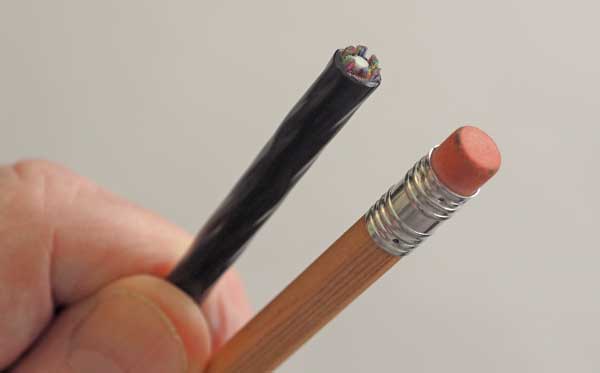
Topic: Fiber Optic Cable |
Table of Contents: The FOA Reference Guide To Fiber Optics |
Fiber
Optic Cable 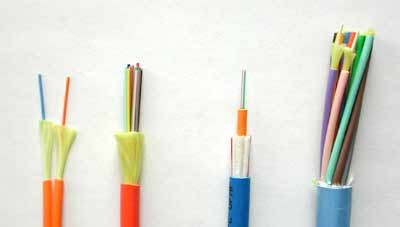 Cable Types: (L>R): Zipcord, Distribution, Loose Tube, Breakout Cable provides protection for the optical fiber or fibers within it appropriate for the environment in which it is installed. Fiber optic "cable" refers to the complete assembly of fibers, other internal parts like buffer tubes, ripcords, stiffeners, strength members all included inside an outer protective covering called the jacket. Fiber optic cables come in lots of different types, depending on the number of fibers and how and where it will be installed. It is important to choose cable carefully as the choice will affect how easy the cable is to install, splice or terminate and what it will cost. Cable's job is to protect the fibers from the environment encountered in an installation. Will the cable become wet or moist? Will it have to withstand high pulling tension for installation in conduit or continual tension as in aerial installations? Does it have to be flame-retardant? Ultra flexible? Will the cable be exposed to chemicals or have to withstand a wide temperature range? What about being gnawed on by a woodchuck or prairie dog? Inside buildings, cables don't have to be so strong to protect the fibers, but they have to meet all fire code provisions. Outside the building, it depends on whether the cable is buried directly, pulled in conduit, strung aerially or whatever. All cables are comprised of layers of protection for the fibers. Most all start with standard fiber with a primary buffer coating (250 microns) and add:
Look at the pictures below to see how each type of cable incorporates these components.
Simplex and zip cord 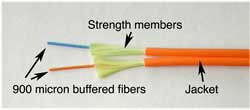 These types are used mostly for patch cord and backplane applications, but zipcord can also be used for desktop connections. Simplex cables are one fiber, tight-buffered (coated with a 900 micron buffer over the primary buffer coating) with Kevlar (aramid fiber) strength members and jacketed for indoor use. The jacket is usually 3mm (1/8 in.) diameter. Zipcord is simply two of these joined with a thin web. Distribution cables 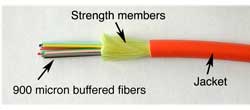 Distribution cable is the most popular indoor cable, as it is small in size and light in weight. They contain several tight-buffered fibers bundled under the same jacket with Kevlar strength members and sometimes fiberglass rod reinforcement to stiffen the cable and prevent kinking. These cables are small in size, and used for short, dry conduit runs, riser and plenum applications. The fibers are double buffered and can be directly terminated, but because their fibers are not individually reinforced, these cables need to be broken out with a "breakout box" or terminated inside a patch panel or junction box to protect individual fibers. Breakout cables 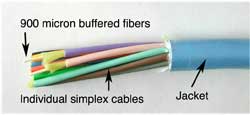 Breakout cable is a favorite where rugged cables are desirable or direct termination without junction boxes, patch panels or other hardware is needed. They are made of several simplex cables bundled together insdie a common jacket. This is a strong, rugged design, but is larger and more expensive than the distribution cables. It is suitable for conduit runs, riser and plenum applications. It's perfect for industrial applications where ruggedness is needed. Because each fiber is individually reinforced, this design allows for quick termination to connectors and does not require patch panels or boxes. Breakout cable can be more economic where fiber count isn't too large and distances too long, because is requires so much less labor to terminate. Loose tube cables 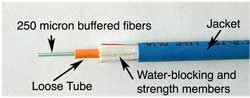 Loose tube cables are the most widely used cables for outside plant trunks because it offers the best protection for the fibers under high pulling tensions and can be easily protected from moisture with water-blocking gel or tapes.These cables are composed of several fibers together inside a small plastic tube, which are in turn wound around a central strength member, surrounded by aramid strength members and jacketed, providing a small, high fiber count cable. This type of cable is ideal for outside plant trunking applications, as it can be made with the loose tubes filled with gel or water absorbent powder to prevent harm to the fibers from water. It can be used in conduits, strung overhead or buried directly into the ground. Some outdoor cables may have double jackets with a metallic armor between them to protect from chewing by rodents or kevlar for strength to allow pulling by the jackets. Since the fibers have only a thin buffer coating, they must be carefully handled and protected to prevent damage. Loose tube cables with singlemode fibers are generally terminated by spicing pigtails onto the fibers and protecting them in a splice closure. Multimode loose tube cables can be terminated directly by installing a breakout kit, also called a furcation or fan-out kit, which sleeves each fiber for protection. Micro
Cables
Microcable
is a term applied to a new class of cables that are very
high density cables. Two fiber developments make a
microcable feasible.
Bend insensitive fiber allows fibers to be packed
into cables with much higher density since the fibers are
not as sensitive to the stress caused by the crowded
fibers. In addition, the bend insensitive fibers can be
coated with smaller diameter primary buffer coatings, 200
microns or less compared to 250 microns for conventional
fibers, allowing more fibers to be packed into a smaller
space. The
differences between conventional and micro cables are
substantial. A 144 fiber loose tube cable is typically
15-16mm diameter while a comparable micro cable is only
about 8 mm diameter - half the size and about one-third
the weight. The smaller size allows for much larger fiber
counts, over 3,000 fibers in some designs. Microcables are available for both premises and outside plant installations. Their small size allows a different installation technique where the cable is "blown" into micro ducts, plastic tubes much smaller than conventional fiber innerducts or conduits. The cable is not really blown into the duct but floated on air to reduce friction then pushed into the duct. Ribbon Cable 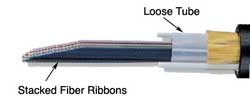 Ribbon cable is preferred where high fiber counts and small diameter cables are needed.This cable has the most fibers in the smallest cable, since all the fibers are laid out in rows in ribbons, typically of 12 fibers, and the ribbons are laid on top of each other. Not only is this the smallest cable for the most number of fibers, it's usually the lowest cost. Typically 144 fibers only has a cross section of about 1/4 inch or 6 mm and the jacket is only 13 mm or 1/2 inch diameter! Some cable designs use a "slotted core" with up to 6 of these 144 fiber ribbon assemblies for 864 fibers in one cable! Since it's outside plant cable, it's gel-filled for water blocking or dry water-blocked. Another advantage of ribbon cable is Mass Fusion Splicers can join a ribbon (12 fibers) at once, making installation fast and easy. Ribbon pigtails are spliced onto the cable for quick termination. Some manufacturers have introduced "flexible ribbons" that are not solid 12 fiber ribbons but are 12 fibers joined with periodic connections to the fibers next to it. These ribbons are more flexible and allow ribbon cables of new construction types, including rolled up ribbons in loose tubes instead of hard ribbons that have to be stacked up and can bend in only one direction. High Fiber Count Cables 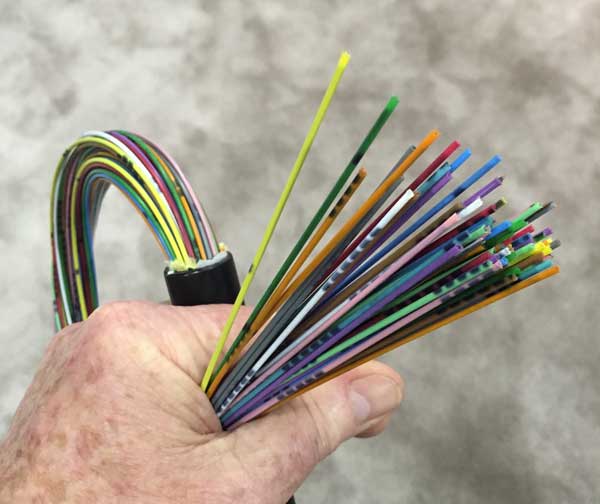 This 1728 fiber cable is under 25mm or 1" diameter. It uses 200 micron buffer fibers Below are two cables with 1728 and 3456 fibers. 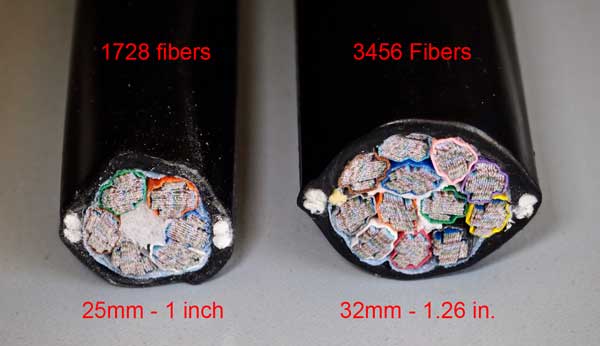 These high fiber count cables are very high density and often use regular or flexible ribbons since ribbon splicing is necessary to splice these cables in any reasonable time. They are usually made with smaller diameter buffer coatings, 200 instead of 250 microns, and bend-insensitive fibers that allow more densely packing fibers into smaller diameter like microcables above, but with very large numbers of fibers, 1728, 3456 or 6912 fiber cables now being available. They are primarily used for short runs in data centers or metropolitan areas. More on high fiber count cables. Armored Cable 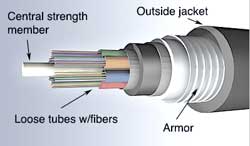 Armored cable is used in direct buried outside plant applications where a rugged cable is needed and/or rodent resistance. Armored cable withstands crush loads well, needed for direct burial applications. Cable installed by direct burial in areas where rodents are a problem usually have metal armoring between two jackets to prevent rodent penetration. Another application for armored cable is in data centers, where cables are installed underfloor and one worries about the fiber cable being crushed. Armored cable is conductive, so it must be grounded properly. Aerial cable 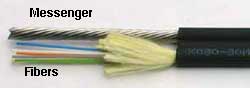 Aerial cables are for outside installation on poles. They can be lashed to a messenger or another cable (common in CATV) or have metal or aramid strength members to make them self supporting. The cable shown has a steel messenger for support. It must be grounded properly. 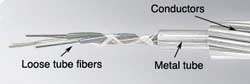 A widely used aerial cable is optical power ground wire (OPGW) which is a high voltage distribution cable with fiber in the center. The fiber is not affected by the electrical fields and the utility installing it gets fibers for grid management and communications. This cable is usually installed on the top of high voltage towers but brought to ground level for splicing or termination. Even More Types Of Cable Are Available: There's double-jacketed indoor/outdoor, dry water-blocked, simple jacketed POF, etc. Every manufacturer has it's own specialties and sometimes their own names for common cable types, so it's a good idea to get literature from as many cable makers as possible. And check out the smaller cable companies; often they can save you a bundle by making special cable just for you, even in relative small quantities. Air-Blown Fiber 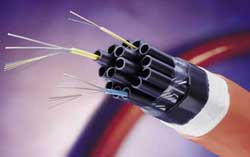 Another "cable" type is not really cable at all. By installing a "cable" which is just a bundle of empty plastic tubes, you can "blow" fibers into the tubes using compressed gas as needed. If you need to upgrade, blow out the old fibers and blow in new ones. Both indoor and outdoor versions of air-blown fiber cables are available and its even been used for FTTH. Special fibers are required that have been coated for easier blowing through the tubes, but any singlemode or multimode fiber is available. It's more expensive to install since the tubes must be installed, special equipment and trained installers are needed but can be cost effective for upgrades. Hybrid and Composite Cables These two types of cables are often confused. In standards, the distinction between hybrid and composite cables has flipped several times in the history of fiber optics and differed among standards bodies. A hybrid cable originally meant a cable with two types of fibers, usually MM and SM, or a hybrid patchcord with, for example, a SC connector on one end and LC on the other end. In the beginning a composite cable was defined per the US National Electrical Code: NEC Article 500.8(F) “Optical fiber cable contains conductors that are capable of carrying current (composite optical fiber cable)" More recent standards like the ones from IECA (Insulated Cable Engineers Association) use the term hybrid for cables with fiber and conductors. Two examples: Hybrid Cables and FTTA cables Cable Design Criteria Choosing a cable requires consideration of all the environmental factors involved during installation and during the cable's lifetime. Here are some of the most important factors. Pulling Strength: Some cable is simply laid into cable trays or ditches, so pull strength is not too important. But other cable may be pulled thorough 2-5 km or more of conduit. Even with lots of cable lubricant, pulling tension can be high. Most cables get their strength from an aramid fiber (Kevlar is the duPont trade name), a unique polymer thread that is very strong but does not stretch - so pulling on it will not stress the other components in the cable. The simplest simplex cable has a pull strength of 100-200 pounds, while outside plant cable may have a specification of over 800 pounds. Bending Limits (Bend Radius): The normal recommendation for fiber optic cable bend radius is the minimum bend radius under tension during pulling is 20 times the diameter of the cable. When not under tension, the minimum recommended long term bend radius is 10 times the cable diameter. Always check the cable specifications for cables you are installing as some cables such as the high fiber count cables have different bend radius specifications! 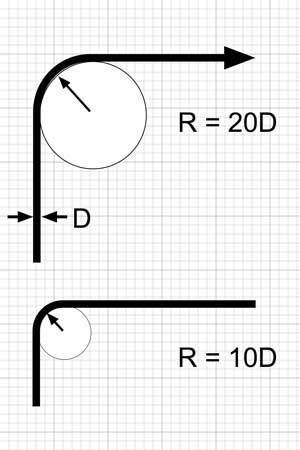 Under tension (top) and after pulling (bottom) Bend radius example: A cable 13mm (0.5") diameter would have a minimum bend radius under tension of 20 X 13mm = 260mm (20 x 0.5" = 10") That means if you are pulling this cable over a pulley, that pulley should have a minimum radius of 260mm/10" or a diameter of 520mm/20" - don't get radius and diameter mixed up! Water Protection: Outdoors, every cable must be protected from water or moisture. It starts with a moisture resistant jacket, usually PE (polyethylene), and a filling of water-blocking material. The usual way is to flood the cable with a water-blocking gel. It's effective but messy - requiring a gel remover (use the commercial stuff - it's best- -but bottled lemon juice works in a pinch!). A newer alternative is dry water blocking using a miracle powder - the stuff developed to absorb moisture in disposable diapers. Check with your cable supplier to see if they offer it. Crush Loads or Rodent Penetration: Armored cables are used because their strong jackets withstand crushing and rodent penetration. Direct burial OSP cables are usually armored or installed in conduit. Armored indoor cables are available with NEC rated jackets for placement with other cables under false floors, as in data centers. Fire Code Ratings: Every cable installed indoors must meet fire codes. That means the jacket must be rated for fire resistance, with ratings for general use, riser (a vertical cable feeds flames more than horizontal) and plenum (for installation in air-handling areas. Most indoor cables use PVC (polyvinyl chloride) jacketing for fire retardance. In the United States, all premises cables must carry identification and flammability ratings per the NEC (National Electrical Code) paragraph 770. These ratings are:
 Grounding and Bonding Any cable that includes any conductive metal must be properly grounded and bonded per the NEC for safety. Indoor cables rated OFC, OFCG, OFCR or OFCP and outdoor cables with metallic strength members or armor must be grounded and bonded. All composite cables must be properly grounded and bonded also. Cable Color Codes Outdoor cables are generally black but premises cables are color-coded. De facto standard color codes for cable jackets have been yellow jackets for singlemode and orange jackets for multimode. With two multimode fibers now in common use, 62.5/125 and 50/125, and four versions of 50/125 fiber, a more comprehensive industry standard for color codes was required. It's important to follow the color code conventions and TIA 598 standards to prevent mixing up cables. Fiber Color Codes Inside the cable or inside each tube in a loose tube cable, individual fibers will be color coded for identification. Fibers generally follow the convention created for telephone wires except fibers are identified individually, not in pairs. Since most loose tube cables have 12 fibers per tube, colors are specified for fibers 1-12, then tubes are color coded in the same manner, up to 144 fiber cables. In ribbon cables, each ribbon is color coded in this format then ribbons are stacked. For splicing long cable runs from similar cables (called concatenation), like color fibers are spliced to ensure continuity of color codes throughout a cable run.
Choosing Cables Choosing a fiber optic cable for any given application requires considering two issues, installation requirements and environmental or long-term requirements. Installation requirements include where and how the cable will be installed, such as pulled in conduit outdoors or placed in cable trays in a building. Long term requirements need to consider moisture or water exposure, temperature, tension (aerial cables), or other environmental factors. You should contact several cable manufacturers (two minimum, three preferred) and give them the specs. They will want to know where the cable is going to be installed, how many fibers you need and what kind (singlemode, multimode or both in what we call "hybrid" cables.) You can also have a "composite" cable that includes copper conductors for signals or power. The cable companies will evaluate your requirements and make suggestions. Then you can get competitive bids. Since the cable plant design will call for a certain number of fibers, consider adding spare fibers to the cable - fibers are cheap compared to installing more cables. That way, you won't be in trouble if you break a fiber or two when splicing, breaking-out or terminating fibers. And consider future expansion needs. Most users install many more fibers than needed, especially adding singlemode fiber to multimode fiber cables for campus or premises backbone applications. More information on cables Videos on cable design, pulling and preparation on the FOA Channel on  General Guidelines For Installing Fiber Optic Cable Here are some general guidelines for installing fiber optic cables that should be read by everyone before installing any cable. More information on installation. Test Your Comprehension Table of Contents: The FOA Reference Guide To Fiber Optics |
|
|