The Fiber Optic Association - Tech Topics
- Does Glass "Flow"?
-
Ever hear the rumor that glass is a
"supercooled liquid" that flows over time?I've heard it for years. It
has been said that the uneven glass in old windows "flowed" over
centuries to look uneven. I've even heard it about fiber that has only
been made twenty years ago.
The rumor surfaced on a mail list I monitor
recently, so I tried to track it down. Below are articles that debunk
this rumor! At the flow rate of glass (well it does flow, but very
slowly), the glass in old windows would need longer than the age of the
universe to flow that much! (And I suspect the "Big Bang" would break
quite a few of those windows!)
- Science News magazine. This is a great,
readable article that tells the story well!
- http://www.sciencenews.org/sn_arc98/5_30_98/fob3.htm
-
- And this article was posted on the SCTE
Mailing List in June, 1999:
Economist - Science And Technology
Non-dribbling glasses - EVEN so rational a subject as science has
its myths. And like the more
traditional sort, scientific myths are often used to illustrate a
general truth. One myth which weaves its way from textbook to textbook
is that the reason the glass in old windows (especially medieval
church
windows) is thicker at the bottom than at the top is because
glass, despite its apparent solidity, is actually a liquid. Given
enough
time, therefore, it will flow from the top of a window pane to the
bottom, accumulating there as a perceptible bulge.
- In the abstruse world of physics, glass
is indeed classified as a liquid
(albeit a supercooled and therefore not very mobile one). The myth of
the ancient window pane has therefore been thought of as a good way to
show students that the everyday meaning of the word "liquid" is not
completely subverted by thinking of glass as a liquid too.
- Putting the myth to the test, several
researchers have recently made a
stab at calculating how fast glass actually flows. Unfortunately for
the
textbooks, the latest estimate, made by Yvonne Stokes of the
University
of Adelaide, and which will be reported in the Proceedings of the
Royal
Society next month, is that it would take over 10 million years for a
window
pane to flow perceptibly.
- Dr Stokes's calculations, which use the
equations of fluid dynamics,
also show that a thickening at the bottom of a pane of glass would not
result in a thinning at its top, as might naively be expected. Rather,
the flow of glass would cause a reduction in the overall height of the
pane. Even a 5% thickening at the bottom of a window a metre high
would
result in a shrinkage of the window's height by about a centimetre. In
other words, if the original myth were correct, old windows would have
gaping holes in them.
- That does, however, leave the question of
what the real reason is that
the glass in old windows tends to be thicker at the bottom than at the
top. Perhaps it is just that medieval glaziers preferred it that way.
Here is another
more recent scientific
report from Penn State about Westminister Abbey that indicates the
time scale would be billions of years.

-
-
- Photos Of Older Glass
- In October, 2006, we (JH) visited the
Henry Wadsworth Longfellow House in Cambridge, MA, which was built in
the 1740s. Here the glass shows typical circular unevenness from
having been blown as a globe, flattened to a disk and cut to shape.
The glass is even obviously thicker and more uneven at the bottom!
-
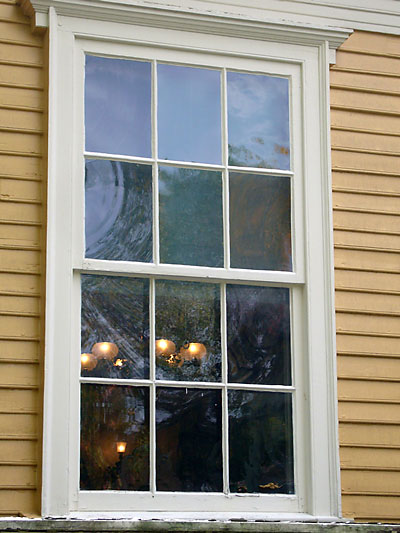
- Note the second pane down on the left
with the circular variations in thickness and the uneven reflections
from other panes.
-
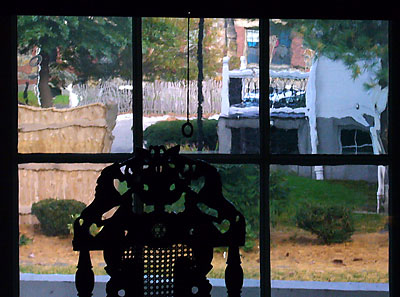
- Here the panes are quite uneven, as shown
by the distortions.
-
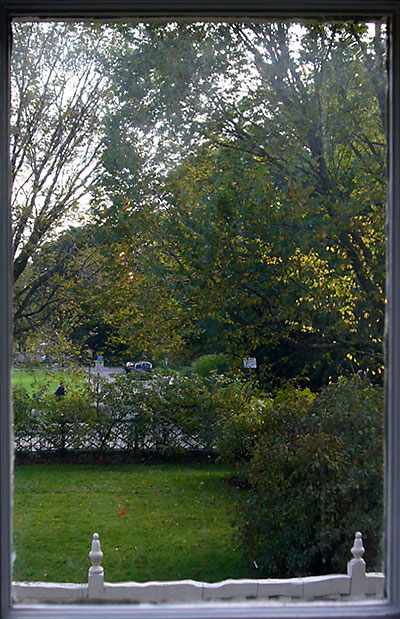
- Now look how the bottom of the pane has
lots of distortion, but the rest is fairly clear. Can you see how the
rumors of glass flowing to the bottom of the pane got started?
-
-
-
-
-
(C) 2002-2017, The Fiber Optic Association,
Inc.
More detailed information can be found on
the FOA Online Reference Guide.
Return To The FOA
Home Page
Return To FOA Tech
Topics