
The Fiber Optic Association - Tech Topics
Note: This document is of historical interest. It was written in 2002 when "Centralized Fiber" was still new in TIA standards. Today, optical LANs (OLANs), especially Passive OLANs (POLs) based on fiber to the home passive optical networks, can build LANs that cost half as much to build and one tenth as much to operate. See OLANs.
Architects and building engineers take note: your rules and mind set for the design of future office buildings will change. Specifically, the size of and need for wiring closets will be reduced. Eventually, wiring closets can disappear! This reduction in size and importance is due to two trends, which have been and, currently, are gaining importance and strength. These two trends are: the increasingly frequent justification for fiber to the desk [FTTD]; and voice over IP [VoIP].
Fiber to the desk is finding increased acceptance because of several factors, the most important of which is reduced initial installed cost. This reduced initial installed cost results from reduction or elimination of three sets of costs.
The first of these sets is the cost for construction. With commercial costs in the range of $100-$200 per square foot, elimination of ten foot by fifteen foot wiring closets in a ten story building saves $150,000 to $300,000.
The second of these sets is the cost of network equipment in the closets. Such equipment includes hubs, switches, enclosures and patch panels. This equipment is replaced with ports in a centrally located distribution facility. This relocation results in at least two cost reductions: reduced cost/port through increased port utilization and reduced network maintenance costs, Since this equipment is not completely eliminated, but relocated, it is difficult to quantify the size of this cost reduction.
The third of these sets is the support costs, which is the cost of equipment required to support the network equipment in the closets. These support costs include the costs for racks, cable trays, surge suppression, dry fire suppression and dedicated environmental control. The largest of these costs tends to be the cost for dedicated environmental control.
When containing substantial electronics, closets must have dedicated temperature control. This control compensates for two common conditions. The first condition is the need for reverse control during the cool season. In cool seasons, electronics in wiring closets need cooling while the rest of the building needs heating. The second condition results from energy conservation: many commercial office buildings have no, or minimal, the environmental control during weekends. The cost of dedicated control can be $5000-$20,000 per closet, or $50,000 to $200,000 for a ten story building with one closet per floor. When these three sets of costs are reduced or eliminated, it is possible to achieve total saving of $500,000 for a ten-story building with one closet per floor. Recently, a BICSI RCDD justified use of fiber to the desk even though the fiber switch blades were nearly three times the cost of UTP switch blades.??call mike to check out this reference
The old argument against fiber to the desk has been increased cost of the fiber electronics. [Note that the cable and connectors have been at cost parity with UTP costs for several years.] While this argument has some validity, it ignores the most important cost, which is total installed cost. When the support costs of wiring closets are eliminated, the fiber electronics can be more expensive than UTP electronics and still allow for a total initial installed cost which is less than that of the horizontal UTP/vertical fiber design. Believe it or not, fiber becomes cheaper than UTP!
Recent work by Pearson Technologies Incorporated and the Fiber Optic LAN subcommittee of the EIA demonstrates this new reality. This work has resulted in a cost model and spreadsheets that demonstrate reduced initial installed cost in certain scenarios for both new builds and retrofits.
When the fiber to the desk design is used, there is no need for wiring closet space for electronics and supporting hardware. In the model, the connections between horizontal and vertical riser fibers are by mechanical splices, which can easily be housed in a wall-mounted enclosure. Such an enclosure is smaller and less expensive than rack mounted enclosures, which include integral patch panels and volume for fiber service loops. Because of this reduced size, such wall mounted enclosures can be mounted anywhere in office space and do not need a closet for their use!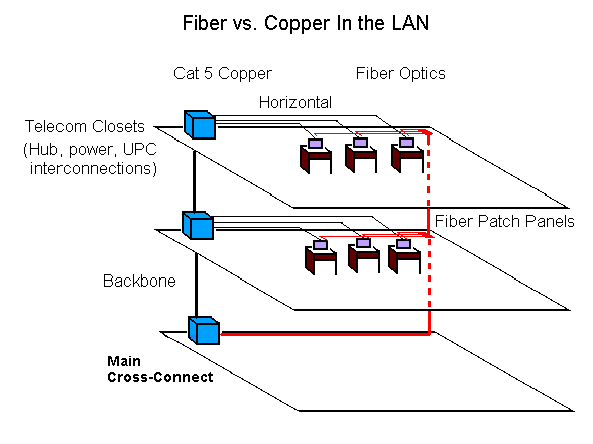
Fiber to the desk network designs result in a reduction in the space required in closets. Closet size and cost can shrink. In fact, the cost model assumes only a 50 % reduction in the size and cost of the wiring closets. With this reduction, a number of the fiber to the desk scenarios offer initial installed costs which are lower than those for the horizontal UTP, vertical fiber network design.
The wiring closets are still required for telephone connections. However, when VoIP is integrated into the network, such connections are already provided by the fiber to the desk design. Then, wiring closets become unnecessary. With this elimination of wiring closets, the cost model supports fiber to the desk more strongly than at the present.
In addition to changes in wiring closets, architects and building designers will respond to changing requirements elsewhere in the building. With increased fiber counts in the vertical riser, architects will need to increase conduit sizes. With increased number of connections and electronic ports in the central distribution facility [CDF] for network services, architects will need to increase the CDF size. This facility, in the basement or at another central location, will require increasing space to accommodate the ports which were in the separate wiring closets. The use of the small form factor connectors and their electronics will reduce this increase in space to less than one for one.
These changes in rules and mind set will have consequences for those other than architects and building designers. The manufacturers of mechanical splices, wall mounted enclosures, small form factor fiber connectors, and 100BaseSX electronics will see increased opportunities. Switch manufacturers will find demand for increased fiber port count switches. Cable manufacturers will find demand new designs with higher fiber counts in smaller cables for riser applications. The 600 µm buffer tube may become the king of the indoor network. The MT type connectors may find increased use in the CDF.
Small form factor connector manufacturers will find increased demand for their products, since their size enables reductions in enclosure volume, cost and room size in the CDF.
In conclusion, fiber to the desk is not a technology justifiable in the future. It is a technology justifiable now. Architects, building engineers and network planners need to reexamine their network design decisions to ensure that initial installed cost and life cycle cost analyses support their decisions to implement anything other than FTTD!
Eric R. Pearson, CPC, CFOS
President
© 2002 Pearson Technologies Incorporated